Thesis Statement怎么构建?从Topic、Claim到Evidence的完整写作方法
Thesis Statement到底是“想出来”的,还是可以一步一步搭出来的?
很多留学生写essay时,会把Thesis Statement想得特别神秘。Introduction前面写得还挺顺,一到最后一句突然停住:
“所以……我的Thesis到底应该写什么?”
其实大多数情况下,一个好的Thesis Statement并不是靠灵感突然蹦出来的。
它更像搭积木。
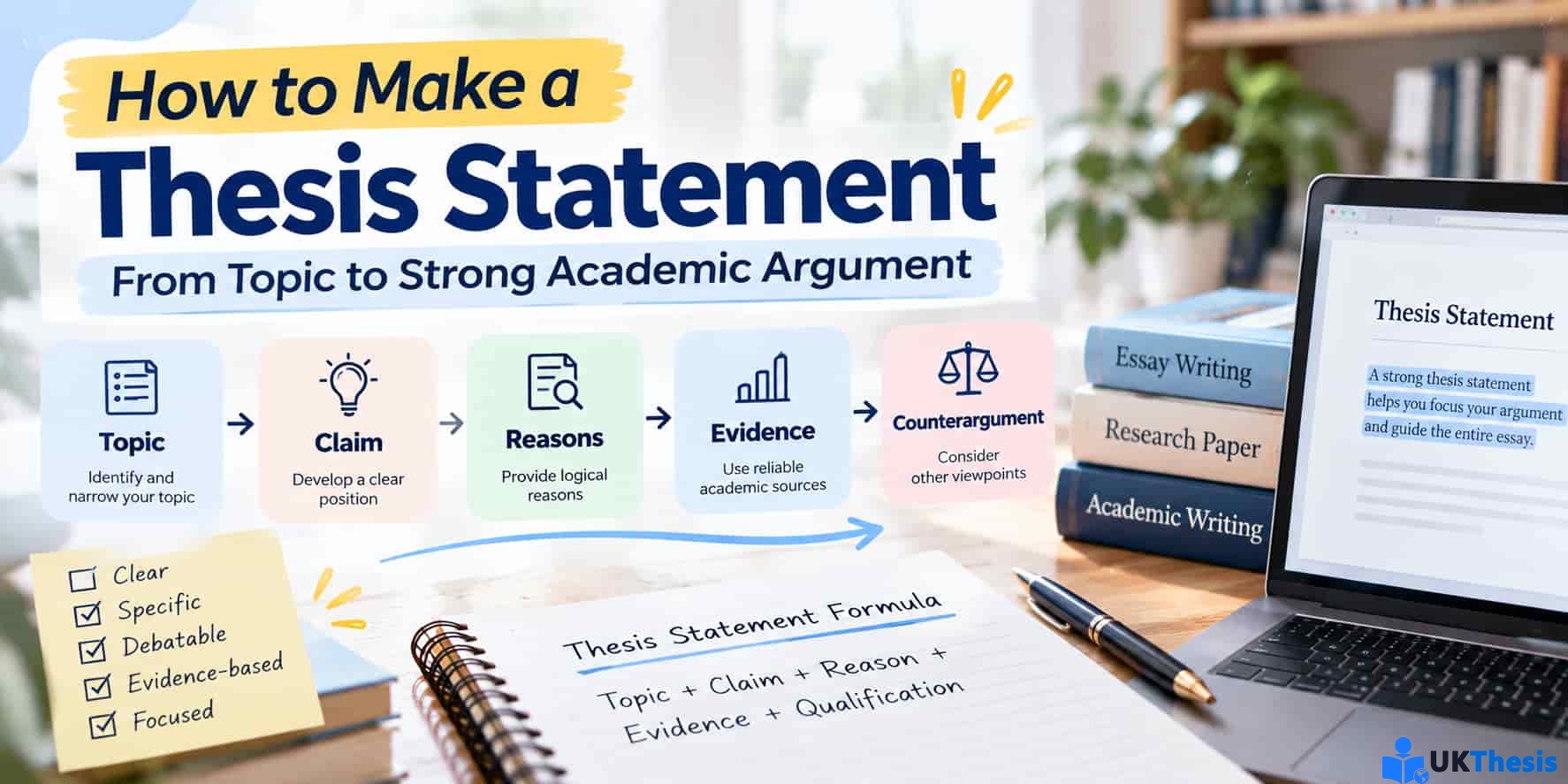
你需要先确定Topic,再形成Claim,然后找到Reasons和Evidence,最后考虑Counterargument和Limitations。
一步一步搭下来,原本一句很普通的Topic,才会慢慢变成真正能够控制Essay结构的Academic Argument。
这篇文章就从最基础的构建逻辑开始,看看如何从一个宽泛Topic,一步一步写出清楚、具体而且能够被Evidence支持的Thesis Statement。
一、Why Is a Thesis Statement So Important?
Thesis Statement最重要的作用,并不只是“老师要求Introduction里必须有一句”。
它真正的价值是帮助你缩小论文范围、组织思路,并建立整篇文章的Argument Direction。
如果你自己都不知道这篇Essay最终想证明什么,那么写Body Paragraph的时候很容易出现:
第一段讨论A;
第二段突然讨论B;
第三段觉得C也挺重要,又加进去;
写到Conclusion才发现三段几乎没什么关系。
这也是为什么很多文章Reference不少、字数也够,但读起来还是有一种“资料都在这里,可是Argument去哪了”的感觉。
一个清楚的Thesis Statement可以帮助你回答:
What am I trying to prove?
Why does this argument matter?
What evidence will I use?
How should my body paragraphs be organised?
二、Thesis Statement不是Topic
这是最常见的第一个错误。
比如:
Topic:
Remote Working
这只是主题。
再写成:
This essay discusses remote working.
仍然不是一个真正的Thesis。
因为读者依然不知道:
你准备讨论Remote Working的什么问题?
效率?员工满意度?Organisational Culture?Work-Life Balance?Leadership?
更不知道你最终形成了什么判断。
所以从Topic到Thesis的第一步,就是把:
“我要写什么”
变成:
“关于这个问题,我准备证明什么。”
三、一个Thesis Statement通常包含哪些元素?
原来的写作方法里有一个很实用的思路:先把Thesis拆成几个基本组成部分。
| Element | 要解决的问题 | 示例 |
|---|---|---|
| Topic | 文章讨论什么? | Remote Working |
| Claim | 你对此有什么判断? | Remote working can improve employee autonomy |
| Reason | 为什么? | Greater flexibility and control over working arrangements |
| Qualification | 什么情况下成立? | When communication and management support are effective |
| Counterargument | 有什么不同观点? | Remote working may weaken social interaction |
把这些东西组合起来以后,就可以得到:
Although remote working may reduce informal social interaction, it can improve employee autonomy and engagement when organisations provide effective communication, managerial support and appropriate job design.
这个Thesis比一句:
Remote working has advantages and disadvantages.
明显强很多。
四、一个很好用的Thesis Statement构建公式
初学阶段可以先使用下面这个逻辑:
Topic + Claim + Reason + Qualification
如果题目本身具有争议,还可以加入:
Counterargument + Claim + Reasons
例如:
Topic:Online Learning
Claim:Blended Learning比完全Online Learning更适合大学教育。
Reason:因为它兼顾flexibility和face-to-face interaction。
Qualification:前提是digital resources和course design足够完善。
最后组合成:
Although online learning provides greater flexibility and access to digital resources, blended learning offers a more effective model for university education because it combines online accessibility with face-to-face discussion, collaboration and academic support.
需要说明的是,这个“公式”是训练思路用的。
不要以后每篇Essay都变成同一句:
Although X, this essay argues Y because A, B and C.
掌握逻辑以后,语言还是要根据题目自然变化。
五、Step 1:先把Essay Question真正拆开
很多Thesis Statement写不出来,其实问题根本不在Thesis本身。
而是assignment Question还没有拆明白。
例如:
To what extent has social media changed consumer purchasing behaviour?
先不要急着写Introduction。
把题目拆成:
| Topic | Social Media |
| Outcome | Consumer Purchasing Behaviour |
| Command Word | To what extent |
| 真正的问题 | Social Media到底在多大程度上改变了消费者购买行为? |
看到To what extent以后,你就应该知道:
老师通常不是只想看到:
Yes, social media affects consumers.
而是希望你判断:
影响有多大?通过什么机制?有没有其他因素?
六、Step 2:把宽泛Topic缩小
原文强调Thesis要帮助作者“Narrow the Focus”,这个思路非常重要。
比如:
Too Broad:
Technology affects education.
这个范围大得几乎没有办法写。
Technology包括什么?
AI?Learning Management Systems?VR?Online Learning?
Education又是小学、中学还是大学?
所以需要不断缩小:
Technology
↓
Generative AI
↓
Generative AI in Higher Education
↓
Generative AI and University Assessment
到这里,就已经明显好写很多。
七、Step 3:先写一个非常普通的Working Thesis
不要追求第一版就完美。
比如:
Question:
How does generative AI affect university learning?
第一版完全可以只写:
Generative AI affects university learning.
很弱。
但是没关系。
它的作用只是让你开始。
接着不断问:
How?
可能是:
Personalised Learning;
Immediate Feedback;
Information Access;
Academic Integrity;
Independent Thinking。
然后再继续筛选。
八、Step 4:形成真正的Claim
Topic和Claim最大的区别在于:
Claim必须表达一个需要Evidence才能成立的判断。
比如:
Topic:
Influencer Marketing
Fact:
Influencer marketing is widely used on social media.
Claim:
Influencer marketing is most effective when consumers perceive the influencer as credible and genuinely aligned with the promoted brand.
后一句就已经可以被研究:
Credibility到底有没有影响?
Brand Fit重要吗?
不同年龄消费者一样吗?
不同Product Category一样吗?
这就是Academic Argument开始出现的地方。
九、Step 5:给Claim补上Reasons
如果一个Thesis只有Position,没有Reason,通常还是会显得比较单薄。
例如:
Weak:
Universities should use blended learning.
为什么?
所以需要补Reason:
Universities should adopt blended learning because it combines the flexibility of digital resources with the interaction and collaborative learning available in face-to-face teaching.
这样正文的方向也自然出现:
Digital Flexibility;
Access to Resources;
Classroom Interaction;
Collaborative Learning。
十、Step 6:加入Qualification,让观点不要太绝对
Academic Writing里很少有复杂问题能够简单地用:
always / never / everyone / completely
解决。
所以很多好的Thesis还需要说明:
这个观点在什么情况下成立。
例如:
Too Absolute:
Remote working improves employee productivity.
More Academic:
Remote working can improve employee productivity when employees have sufficient autonomy, appropriate digital resources and effective managerial support.
一个简单的when,就把原来过度绝对的观点变成了一个更加值得分析的问题。
十一、Step 7:需要的时候加入Counterargument
原文提出可以把Counterargument加入Thesis,这个方法尤其适合Argumentative Essay。
例如校服这个题目:
Basic Claim:
Schools should not require students to wear uniforms.
如果加入Counterargument:
Although school uniforms may encourage a sense of collective identity, compulsory uniform policies can unnecessarily restrict students' personal expression without necessarily improving academic outcomes.
这样就比简单说“校服不好”成熟很多。
因为作者已经承认:
校服可能有好处。
但仍然解释为什么自己最终形成另一个Judgement。
十二、Counterargument并不是每个Thesis都必须塞进去
这里也需要纠正一个常见误区。
Counterargument很有价值,但并不代表所有Thesis Statement都必须强行包含:
Although...
如果题目主要是Expository或者Analytical,Thesis可以更直接。
例如:
Employee engagement is shaped by the interaction of job autonomy, managerial support, recognition and opportunities for professional development.
这句话本身已经能够承担Analytical Essay的核心作用。
没有必要为了显得“高级”硬塞一个反方观点进去。
十三、Step 8:检查Thesis能不能变成Body Structure
这是一个非常好用的测试方法。
写完Thesis以后问自己:
我能不能从这句话直接拆出正文结构?
例如:
Social media influences young consumers' purchasing intentions primarily through electronic word-of-mouth, influencer credibility and perceived social proof.
那么正文很自然就可以是:
Body 1:Electronic Word-of-Mouth
Body 2:Influencer Credibility
Body 3:Social Proof
如果你的Thesis写完以后,正文还是不知道怎么安排,说明Thesis可能仍然过于模糊。
十四、Weak vs Strong Thesis Statement:差别到底在哪里?
| Topic | Weak Thesis | Strong方向 |
|---|---|---|
| Remote Working | Remote working has advantages and disadvantages. | 说明效果取决于Autonomy、Communication与Job Design |
| AI in Education | AI is changing education. | 分析AI提高学习支持的同时如何影响Independent Thinking |
| Leadership | Leadership is important. | 明确某种Leadership Style通过什么机制产生效果 |
| Social Media | Social media affects consumers. | 明确影响机制及不同Context |
| Sustainability | Companies should be sustainable. | 解释Regulation、Consumer Pressure与Competitive Advantage之间的关系 |
十五、Expository Thesis Statement怎么构建?
Expository Essay的主要任务通常是解释一个概念、过程或者现象。
所以Thesis重点不是提出特别强烈的Position,而是:
明确文章解释什么,以及从哪些方面解释。
例如原来常见的Braille题目。
Weak:
Braille was an important nineteenth-century invention.
这是一句事实性判断,但没有告诉读者Essay真正会分析什么。
可以改成:
The development of Braille transformed access to literacy for blind people, while its wider adoption was shaped by educational institutions, teaching practices and changing social attitudes towards disability.
这个版本明显更Specific,也更容易发展正文。
十六、Argumentative Thesis Statement怎么构建?
Argumentative Essay重点是:
Position + Reasons + Evidence。
例如环境政策题目。
Weak:
Governments should invest more in green energy.
有Position,但Reason不够。
Improved:
Governments should increase long-term investment in renewable energy because it can reduce dependence on fossil fuels, support technological innovation and contribute to national emissions-reduction targets.
这个Thesis已经把正文的三个主要Argument点出来了。
十七、Analytical Thesis Statement怎么构建?
Analytical Essay重点不是简单说“支持还是反对”,而是解释:
Why、How、Relationship和Mechanism。
例如:
Weak:
This essay analyses employee motivation.
Improved:
Employee motivation is influenced not only by financial rewards but also by perceived autonomy, recognition and opportunities for professional development.
这个版本已经明确告诉读者:
文章不会简单讨论“钱重要不重要”,而是比较多种Motivational Factors。
十八、Thesis Statement需要包含所有正文观点吗?
不需要把整篇Essay压缩成一句超长句子。
Thesis应该让读者看到:
核心Topic;
主要Claim;
最重要的Reasoning Direction。
但不需要把每一个Sub-point、Reference、Theory和case study全部塞进去。
否则很容易出现这种情况:
一句话80多个词,写到最后作者自己都忘记句子主语是什么。
Thesis Statement的目标是Focus,不是信息大甩卖。
十九、Thesis Statement一定只能有一句吗?
不一定。
短篇本科Essay通常一句就足够。
但如果Argument比较复杂,两句话也完全可以。
重点不是句数,而是:
读者能不能迅速识别你的Central Argument。
Research Paper和Dissertation尤其不要机械套用“一句话Thesis”的规则,因为这些文章往往还涉及Research Gap、Aim、research Questions和Contribution。
二十、一个完整的Topic → Thesis构建示范
我们用一个Marketing题目完整走一遍。
Topic:
Influencer Marketing
Step 1:缩小范围
Influencer Marketing and Gen Z Purchasing Behaviour
Step 2:Research Question
How does influencer marketing affect Gen Z consumers' purchasing intentions?
Step 3:Working Answer
Influencer marketing affects purchasing intentions.
Step 4:加入Mechanism
Influencer credibility and authenticity affect purchasing intentions.
Step 5:加入Qualification
The effect varies according to brand fit and consumer involvement.
Final Thesis:
Influencer marketing can strengthen Gen Z consumers' purchasing intentions when influencers are perceived as credible and authentic, although its effectiveness varies according to brand–influencer fit and consumers' level of product involvement.
从Topic一路走到这里,你会发现:
一个Thesis Statement其实不是“想一句英文”,而是在不断缩小和明确自己的Argument。
二十一、Thesis Statement自检表
| 检查问题 | Yes / No |
|---|---|
| 我的Thesis是否直接回应Essay Question? | □ |
| 它是否超越了单纯Topic介绍? | □ |
| 是否形成了需要Evidence支持的Claim? | □ |
| 研究范围是否足够Specific? | □ |
| 有没有说明主要Reason或Mechanism? | □ |
| 有没有使用过度绝对的语言? | □ |
| 正文结构能否从Thesis中自然展开? | □ |
| Conclusion是否最终回应了Thesis? | □ |
二十二、写完Essay以后,还要不要修改Thesis?
当然要。
初稿阶段的Thesis通常只是Working Thesis。
随着literature review和正文分析不断深入,你可能发现:
原来以为A最重要,最后Evidence却显示B更关键。
这时候修改Thesis不是“前面写错了”。
反而说明你的Academic Thinking在发展。
比较实用的方法是:
写完Body以后重新回到Introduction,问自己:
现在的Thesis,还准确描述我这篇Essay真正证明出来的东西吗?
如果答案是否定的,就应该修改。
二十三、为什么有时候怎么改都写不好Thesis?
因为问题可能根本不在英文。
你可以不停把:
important
换成:
significant、substantial、considerable
但如果Argument本身没有想清楚,Thesis依然不会变强。
所以遇到卡住的时候,先不要急着找“高级表达”。
先回答:
我的Research Question是什么?
我的Answer是什么?
为什么?
Evidence在哪里?
有没有Limitations或者Counterargument?
这些逻辑一旦清楚,语言通常只是最后一步。
对于正在完成Essay、Assignment、Research Paper或者Dissertation的留学生来说,论文写作辅导真正值得关注的也应该是题目拆解、Argument设计、Thesis Statement、Evidence和Body Structure之间的逻辑关系,而不是单纯替换几个“看起来很高级”的词。
相关阅读
FAQ:How to Make a Thesis Statement常见问题
Q1:Thesis Statement应该先写还是最后写?
建议在正式写正文前先形成一个Working Thesis,用它帮助控制Essay方向;正文完成以后再回头修改,使最终Thesis与实际Argument保持一致。
Q2:Thesis Statement必须包含三个理由吗?
不必须。“三个理由”只是某些基础Essay结构中常见的方法,并不是Academic Writing的统一规则。理由数量应该由题目、字数和Argument决定。
Q3:Thesis Statement一定要写Counterargument吗?
不一定。Argumentative Essay中加入Counterargument通常很有帮助,但Expository或部分Analytical Essay没有必要为了套模板强行加入。
Q4:Thesis Statement应该多长?
没有统一词数。很多短Essay使用一句即可,复杂Argument也可能需要两句话。重点是清楚、具体并能够概括Central Argument。
Q5:Topic Sentence和Thesis Statement有什么区别?
Thesis Statement控制整篇Essay的核心Argument,而Topic Sentence通常控制一个Body Paragraph的主要观点。理想情况下,各个Topic Sentence都应该能够回到Thesis。
Q6:Thesis Statement可以在写作过程中改变吗?
可以,而且非常正常。随着Research和Evidence不断增加,Working Thesis本来就可能需要调整。
Q7:怎样判断我的Thesis是不是太宽?
可以检查自己是否能够在规定Word Count内真正分析Thesis中的每个核心概念。如果一句Thesis同时覆盖多个国家、行业、理论和时间范围,通常就需要进一步缩小。