How to Start a Thesis Statement?从Research Question到Working Thesis的写作步骤
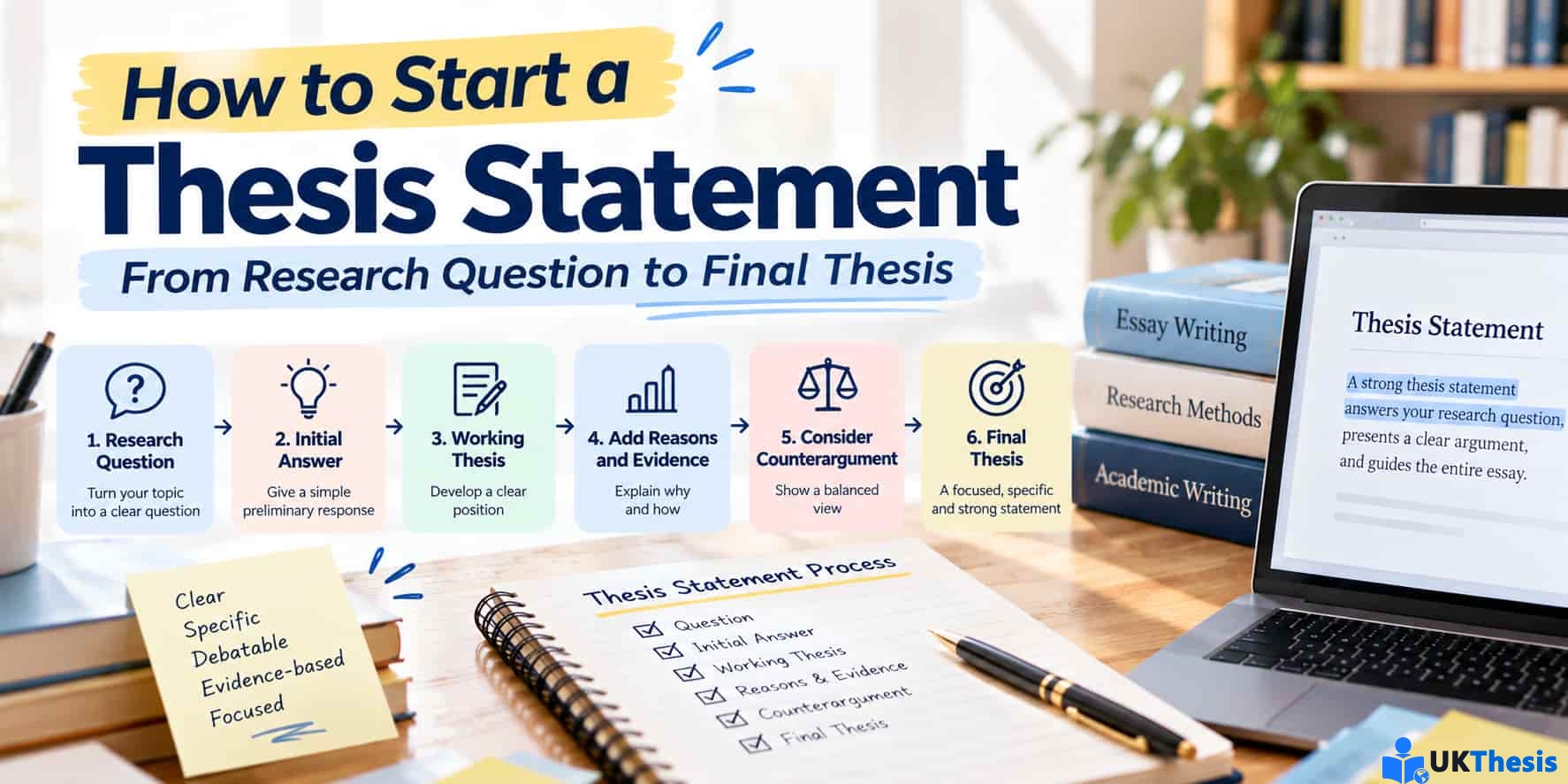
How to start a Thesis Statement?很多留学生真正卡住的地方,并不是不知道Thesis Statement是什么,而是知道它很重要以后,打开Word却不知道第一句话从哪里来。
essay题目已经摆在眼前,Reference也下载了几篇,甚至Introduction的Background都写了两百多词,但到了最关键的位置突然停住:
“所以,我的Thesis Statement到底应该怎么开始?”
其实,一个好的Thesis Statement通常不是坐在那里硬憋出一句“很高级的英文”。更实用的方法是:
research Question → Initial Answer → Working Thesis → Reasons → Qualification → Final Thesis
也就是说,先问一个问题,再给它一个最简单的回答,然后随着Research不断把这个回答变得更具体、更有Evidence、更有分析深度。
下面就按照这个过程,一步一步看看How to Start a Thesis Statement。
一、开始之前先弄清楚:Thesis Statement和Research Question不是一回事
这是原来很多同学特别容易混淆的地方。
Research Question负责“提出问题”。
Thesis Statement负责“给出回答或者核心判断”。
例如:
Research Question:
Has the internet had a positive or negative impact on university education?
这当然可以是一个Question。
但如果把它原封不动放在Introduction最后,说这就是Thesis Statement,就还没有完成真正的Academic Argument。
你需要进一步回答:
Overall, the internet has had a largely positive impact on university education by widening access to academic resources and supporting flexible learning, although its benefits depend on students' digital literacy and ability to evaluate online information critically.
后一句才开始承担Thesis Statement的作用。
所以如果你不知道Thesis怎么开头,最简单的方法之一就是:
先把assignment Topic变成一个你能够回答的问题。
二、Can a Thesis Statement Be a Question?
一般来说,学术Essay中的Thesis Statement更适合采用陈述句,因为它的主要任务是表达文章的central claim、position或者analytical conclusion。
例如:
Question:
Does social media improve or damage university students' academic performance?
这适合作为Research Question。
而Thesis Statement应该进一步回答:
Social media can support university students' academic collaboration and access to information, but excessive and fragmented use may reduce sustained attention and independent study.
这里的关键区别不是“问号能不能出现”,而是:
Thesis必须开始回答问题,而不能只把问题重新问一遍。
三、How Long Should a Thesis Statement Be?
旧的写作资料经常告诉学生:
“Thesis Statement必须是一句话。”
这个说法对于很多短篇本科Essay确实比较实用,但不应该理解成所有Academic Writing的硬性规定。
通常来说:
| 文章类型 | Thesis常见形式 |
|---|---|
| Short Essay | 通常一句即可 |
| Argumentative Essay | 一句清晰的Central Claim,必要时两句 |
| Research Paper | 可能需要1–2句表达较复杂关系 |
| Dissertation | 可能通过Research Problem、Aim、Questions与Central Argument共同体现 |
所以真正值得关心的不是:
“到底32个词还是42个词?”
而是:
读者能不能迅速理解你这篇文章最终准备证明什么。
四、Step 1:Start with a Question
这是开始Thesis Statement最有效的方法之一。
有些Assignment本身已经给了Question。
例如:
To what extent does remote working improve employee productivity?
这种题目已经可以直接进入下一步。
但如果老师只给了一个宽泛Topic,你可以自己把它转换成Question。
例如:
Topic:
Artificial Intelligence in Higher Education
可以变成:
Research Question:
How does generative AI affect university students' learning?
或者进一步缩小:
To what extent can generative AI improve university students' independent learning?
后一种就明显更容易形成Thesis。
五、不同Essay类型,可以从什么Question开始?
原文其实给了三个很好用的方向:Argumentative、Expository和Literary Analysis。
我们可以把它进一步扩展。
| Essay类型 | 起始Question示例 |
|---|---|
| Argumentative Essay | Has the internet had a positive or negative impact on education? |
| Expository Essay | How did the printing press change European society? |
| Literary Analysis | How does Mary Shelley portray Victor Frankenstein? |
| Management Essay | How does transformational leadership influence employee engagement? |
| Marketing Essay | How does influencer credibility affect consumer purchase intention? |
| Research Paper | What factors influence students' acceptance of generative AI tools? |
六、Step 2:Write Your Initial Answer
有了Question以后,不需要马上写一个完美Thesis。
先给它一个非常简单的Answer。
这个阶段得到的通常就是:
Working Thesis。
例如:
Question:
Has the internet had a positive or negative impact on education?
Initial Answer:
The internet has had more positive than negative effects on education.
这还比较粗糙。
但是它已经比:
This essay discusses the internet and education.
前进了很大一步。
因为它已经形成了一个初步Position。
七、什么是Working Thesis?
Working Thesis可以理解成Thesis Statement的“草稿版本”。
它最大的作用不是马上让老师惊叹:
“哇,这句英文真漂亮。”
而是帮助你确定:
Research应该往哪里搜;
哪些Reference值得读;
Body Paragraph应该分析什么;
哪些内容其实已经跑题。
比如:
Working Thesis:
Remote working can improve employee productivity.
接下来Research过程中发现:
Autonomy可能提高Productivity;
Reduced Commuting可能节省时间;
Social Isolation可能降低Engagement;
Job Type影响很大;
Management Support也很关键。
于是Thesis自然就要升级。
八、Step 3:Ask “Why?”
这是从Weak Thesis迈向Strong Thesis特别重要的一步。
写完Initial Answer以后,不要马上满意。
问自己:
Why?
比如:
The internet has had a positive impact on education.
为什么?
可能因为:
扩大了Access to Information;
支持Distance Learning;
方便Academic Collaboration;
增加Digital Learning Resources。
于是可以升级成:
The internet has improved university education by widening access to academic resources, enabling flexible learning and supporting communication between students and educators.
已经明显比第一版丰富。
九、Step 4:再问一句“How?”
Why解决“为什么”,How解决“怎么发生”。
这一步特别适合Analytical Essay。
例如:
Working Thesis:
Influencer marketing affects consumer purchasing decisions.
问:
How?
可能通过:
Credibility;
Trust;
Electronic Word-of-Mouth;
Social Proof;
Brand–Influencer Fit。
于是Thesis可以发展成:
Influencer marketing shapes young consumers' purchasing intentions primarily through perceived credibility, social proof and brand–influencer fit.
现在这句话已经开始具有真正的Analytical Value。
十、Step 5:加入“Under What Conditions?”
大学Essay真正拉开层次的地方,经常就是这一步。
因为很多现实问题并不存在简单的:
Yes / No。
更常见的是:
It depends.
例如:
初步Thesis:
Remote working improves employee productivity.
继续问:
Under what conditions?
可能取决于:
Job Type;
Employee Autonomy;
Communication Quality;
Digital Infrastructure;
Managerial Support。
于是可以得到:
Remote working can improve employee productivity through greater autonomy and reduced commuting time, but its effectiveness depends heavily on job design, communication practices and organisational support.
这就比“Remote Working有好有坏”成熟很多。
十一、Step 6:考虑Counterargument
如果写Argumentative Essay,可以再问:
What would someone who disagrees with me say?
比如你的Thesis认为:
Online learning improves access to higher education.
Counterargument可能是:
Digital Divide;
Student Isolation;
Lower Engagement;
Technology Barriers。
于是更成熟的Thesis可能变成:
Although online learning can create challenges related to digital access and student engagement, it can substantially widen participation in higher education when institutions provide adequate technological and academic support.
这里的重点不是为了显得复杂,故意写“Although”。
而是表明:
你理解这个问题不只有一面。
十二、Internet and Education:从Question到Final Thesis完整示范
我们把原来的Internet例子完整走一遍。
Step 1 — Question:
Has the internet had a positive or negative impact on university education?
Step 2 — Initial Answer:
The internet has had a largely positive impact on university education.
Step 3 — Why?
Because it improves access to information and flexible learning.
Step 4 — Counterargument:
It can also increase distraction and exposure to unreliable information.
Step 5 — Final Thesis:
Although the internet has increased students' exposure to distraction and unreliable information, its overall impact on university education has been largely positive because it has widened access to academic resources, enabled flexible learning and supported collaboration beyond the classroom.
这就是一个Thesis从一句简单回答逐步发展的完整过程。
十三、Printing Press Example:Expository Thesis怎么开始?
原文还用了Printing Press作为Expository Essay例子。
Question:
How did the invention of the printing press change European society?
Initial Answer:
The printing press gave more people access to information.
这句话已经可以作为Working Thesis。
接下来再问:
Access to什么Information?
造成了什么社会变化?
和Literacy、Religion、Education有没有关系?
于是可以发展成:
The printing press transformed European society by expanding access to written knowledge, supporting rising literacy and accelerating the circulation of religious, scientific and political ideas.
这就给后面的正文提供了三个非常清晰的方向。
十四、Frankenstein Example:Literary Analysis Thesis怎么开始?
文学Essay也可以使用同样的方法。
Question:
How does Mary Shelley portray Victor Frankenstein?
Initial Answer:
Shelley portrays Victor Frankenstein negatively.
这还是太简单。
继续问:
How?
通过Ambition?Responsibility?Isolation?Obsession?
又有什么更深的意义?
最终可以发展成:
Mary Shelley portrays Victor Frankenstein as a figure whose obsessive pursuit of knowledge gradually overrides moral responsibility, using his isolation and rejection of the creature to expose the destructive consequences of unchecked ambition.
这就不再是一句简单的Character Description,而开始形成Literary Analysis。
十五、Difference Between a Weak and Strong Thesis Statement
原文后半部分重点讨论了Weak和Strong Thesis的差别。
这里我们可以把它整理得更清楚。
| Weak Thesis | 为什么弱 | Strong Thesis应该怎么改 |
|---|---|---|
| Remote working has advantages and disadvantages. | 几乎没有真正的Position | 明确最终效果及其条件 |
| Social media affects young people. | 范围太大 | 限定对象、结果和作用机制 |
| Leadership is important. | 属于常识 | 说明哪种Leadership、怎样产生影响 |
| This essay discusses AI. | 只有Topic,没有Claim | 提出AI到底造成什么具体变化 |
| Online learning is good. | 过度笼统且缺乏Evidence | 加入Reasons、Context与Limitations |
十六、Strong Thesis第一原则:Make a Claim
一个Strong Thesis通常不能只是Common Knowledge。
例如:
Weak:
Social media has both positive and negative effects.
谁都知道。
它不需要真正的Evidence才能成立。
Stronger:
Social media can strengthen students' access to peer learning communities, but frequent task-switching between academic work and social platforms may undermine sustained concentration.
这个观点开始需要Research来支持,也就有了真正的Academic Discussion空间。
十七、Strong Thesis第二原则:Give the Reader a “So What?”
写完Thesis以后,可以问自己:
So what?
如果读者看完只会说:
“嗯,然后呢?”
Thesis通常还不够强。
例如:
Weak:
Artificial intelligence is increasingly used in universities.
这是事实。
Better:
The increasing use of generative AI is changing university assessment by making traditional take-home assignments less reliable measures of independent student performance.
现在它已经回答了:
为什么这个现象值得讨论。
十八、Strong Thesis第三原则:One Main Idea
一个Thesis可以包含几个Supporting Points,但最好围绕一个Central Idea。
例如:
Problematic:
Social media is useful for marketing, cybersecurity is becoming more important, remote working affects employees, and artificial intelligence is changing businesses.
这不是Thesis。
这是四篇Essay在同一句话里召开联席会议。
真正需要的是Focus。
比如:
Social media marketing influences consumer purchase intention primarily through electronic word-of-mouth, influencer credibility and perceived social proof.
三个Supporting Factors虽然不同,但都服务于同一个Main Idea。
十九、Strong Thesis第四原则:Be Coherent
原文提到Strong Thesis需要Coherent,这一点非常重要。
Thesis里的各个部分必须能够形成逻辑关系。
例如:
Weak:
The internet is useful for advertising, but many websites have weak security.
这两件事情虽然都和Internet有关,但并没有形成一个清晰Argument。
可以缩成一个更聚焦的问题:
The growth of online retail has increased the importance of consumer data protection because digital purchasing requires users to disclose increasingly sensitive personal information.
现在Topic、Claim和Reason之间就连起来了。
二十、Strong Thesis第五原则:不要过度绝对
Strong不等于“说得特别狠”。
例如:
Too Absolute:
Social media destroys students' academic performance.
More Academic:
Heavy and fragmented social media use may reduce sustained academic attention, although its effects vary according to usage patterns and individual study habits.
后一句虽然没有前一句气势汹汹,但更符合Academic Writing。
因为它允许:
Context;
Variation;
Limitations;
Alternative Evidence。
二十一、Thesis Statement应该用什么词开头?
很多同学搜“How to start a thesis statement”,其实是在找一句可以直接套用的开头。
可以参考下面这些Academic Patterns,但不要每篇都机械复制。
| 用途 | 常见表达 |
|---|---|
| 提出Argument | This essay argues that... |
| 有条件的判断 | Although X..., Y depends largely on... |
| 分析机制 | X influences Y primarily through... |
| 评价程度 | X is effective to the extent that... |
| 比较 | While X provides..., Y offers... |
| Research Paper | This paper suggests that... |
但是有一点需要特别提醒:
句型只是外壳。
真正决定Thesis质量的是里面的Argument。
如果观点本身只有:
“Technology is important.”
就算前面加一句:
This essay critically argues that...
它也不会突然变成高分Thesis。
二十二、Thesis Statement和Topic Sentence有什么区别?
这两个也很容易混。
| Thesis Statement | Topic Sentence | |
|---|---|---|
| 控制范围 | 整篇Essay | 一个Body Paragraph |
| 位置 | 通常在Introduction | 通常在Body Paragraph开头附近 |
| 功能 | 表达Central Argument | 表达本段Main Point |
| 关系 | 总论点 | 分论点,应支持Thesis |
最简单的检查方法就是:
每个Topic Sentence能不能回答:“这一段怎样帮助我证明Thesis?”
二十三、写完正文以后一定要回来修改Working Thesis
Working Thesis从名字就能看出来:
它是Working的。
不是签了合同以后永远不能改。
Research过程中,你很可能会发现:
原来的Position太绝对;
Evidence并没有完全支持初始观点;
一个以前没注意到的Factor其实更重要;
Counterargument比想象中更有说服力。
这些都应该反映到Final Thesis里。
因此写完Essay以后,重新问一次:
My essay actually proves what?
然后把Introduction中的Thesis修改到与正文真正的Argument一致。
二十四、从Research Question到Final Thesis:完整模板
如果第一次练习,可以按照下面的顺序做:
1. Topic
Remote Working
2. Research Question
How does remote working affect employee engagement?
3. Initial Answer
Remote working can affect employee engagement positively.
4. Why?
Greater autonomy and flexibility.
5. Counterargument
Reduced social interaction may damage engagement.
6. Under What Conditions?
Management Support + Communication + Job Design.
7. Final Thesis
Remote working can strengthen employee engagement by increasing autonomy and flexibility, but its effectiveness depends on managerial communication, appropriate job design and employees' opportunities for meaningful social interaction.
你会发现,真正有效的“How to Start”不是找一个万能第一句,而是把Question一步一步发展成Argument。
二十五、Thesis Statement自检Checklist
| 检查问题 | Yes / No |
|---|---|
| 我的Thesis是否真正回答Essay Question? | □ |
| 它是一个Claim,而不是单纯Topic吗? | □ |
| 是否说明了Why或How? | □ |
| 研究范围是否足够具体? | □ |
| 是否需要Evidence才能成立? | □ |
| 是否避免always、everyone等绝对表达? | □ |
| 是否考虑了Context或Limitations? | □ |
| 正文每个主要Argument是否能够回到Thesis? | □ |
| Conclusion是否最终回应了Thesis? | □ |
二十六、写不出Thesis时,别先去搜“高级句型”
这应该是我最想提醒留学生的一点。
很多人Thesis写不出来以后,第一反应就是:
“有没有一个高分模板?”
或者:
“有没有什么特别Academic的高级词?”
但真正的问题往往不是Vocabulary。
而是你还没有想清楚:
What is my question?
What is my answer?
Why?
How?
Under what conditions?
What evidence supports it?
这些问题回答清楚以后,Thesis往往会自己慢慢成形。
对于Essay、Assignment、Research Paper或者Dissertation来说,真正有价值的论文写作辅导也应该首先检查Assignment Question、Research Question、Working Thesis、Evidence、Body Argument和Conclusion之间有没有形成完整逻辑,而不仅仅是替换几个所谓的“高级表达”。
相关阅读
FAQ:How to Start a Thesis Statement常见问题
Q1:Thesis Statement可以用Question开头吗?
Research Question当然可以采用问句,但Thesis Statement通常需要进一步给出Answer、Position或者Analytical Claim。重点是Thesis必须开始回答问题,而不只是重新提出问题。
Q2:Thesis Statement第一句一定要写“This essay argues that”吗?
不需要。这只是一个非常常见的Academic Pattern。根据文章类型,也可以直接陈述Claim,或者使用Although、While、X influences Y through等结构。
Q3:什么时候应该开始写Thesis Statement?
通常在初步理解题目并进行基础Research以后,就可以先形成Working Thesis。它能够帮助后续Research和Outline保持方向。
Q4:Working Thesis和Final Thesis有什么区别?
Working Thesis是写作初期的暂时性判断,而Final Thesis应该反映正文Research和Evidence最终支持的核心Argument。因此两者不完全一样是很正常的。
Q5:Thesis Statement必须表达个人意见吗?
不应简单理解成个人意见。Academic Thesis需要建立在Reasoning、Literature、Data或其他可靠Evidence基础上。Argumentative Essay虽然需要Position,但Position必须能够被学术证据支持。
Q6:Thesis Statement应该放在哪里?
很多本科Essay会把Thesis放在Introduction后半部分。但Research Paper和dissertation结构更加复杂,不必机械规定必须是第一段最后一句。
Q7:Thesis Statement写完以后还能改吗?
当然可以,而且通常应该修改。随着Research深入,Evidence可能会改变你的初始判断。最终Thesis应该准确反映正文真正形成的Argument。
Q8:为什么我的Thesis看起来总像一个Topic?
可以在句子后面继续追问Why、How和Under what conditions。如果一句话只是告诉读者“我要讨论什么”,却没有告诉读者“我对此发现或主张什么”,通常仍然只是Topic。