The Campbell’s Company Strategic Management Assignment范文:Porter’s Five Forces、SWOT与竞争战略分析

Food Industry Competition是Strategic Management、Business Strategy、International Business和Management课程里非常常见的一类assignment主题。 如果题目要求分析一家食品企业的竞争环境,通常不会只问“它有哪些竞争对手”,而是希望学生能够结合Porter’s Five Forces、SWOT Analysis、Competitive Strategy和Corporate Strategy,对企业所处行业以及自身战略位置进行系统分析。
The Campbell’s Company就是一个非常适合做这类Assignment的案例。 很多旧资料仍然把它称为Campbell Soup Company,但公司已经在2024年正式更名为The Campbell’s Company。 这个变化并不仅仅是换了一个名字,也反映出企业已经从传统汤类生产商发展成为覆盖Meals & Beverages和Snacks的多品牌食品公司。
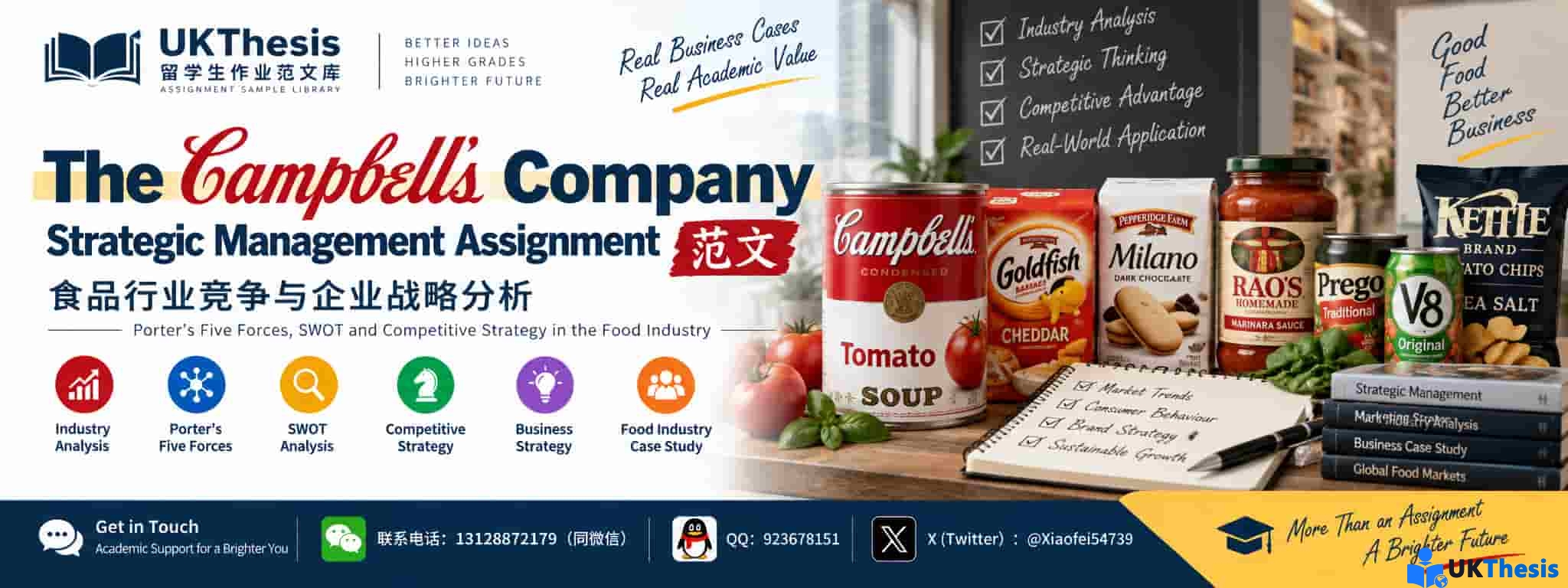
今天的Campbell’s品牌组合包括Campbell’s、Goldfish、Pepperidge Farm、Rao’s、Prego、V8、Kettle Brand、Cape Cod、Pace、Pacific Foods、Snyder’s of Hanover等。 因此,如果现在重新写这篇Assignment,就不能继续把Campbell’s简单理解为“汤类企业”,而应该从portfolio strategy、industry competition、consumer trends、innovation和brand differentiation几个角度重新分析。
1. Introduction
The packaged food industry is highly competitive because companies compete across price, brand recognition, product quality, convenience, health positioning, innovation and distribution. Large firms must also respond to changing consumer pReferences, retailer bargaining power, private-label competition and fluctuating input costs.
The Campbell’s Company provides a useful strategic management case because it operates a diversified portfolio across Meals & Beverages and Snacks while competing with other large consumer packaged goods companies, private-label brands and emerging food businesses.
This assignment analyses Campbell’s competitive environment using Porter’s Five Forces and SWOT Analysis. It then evaluates the company’s business-level and corporate-level strategies, before considering how innovation, brand portfolio management and operational capabilities may support long-term competitive advantage.
2. Company Background:从Campbell Soup到The Campbell’s Company
Campbell’s成立于1869年,是美国历史悠久的食品企业之一。 长期以来,Campbell’s Soup几乎成为公司最具代表性的产品。
但是今天的Campbell’s已经远远不只是Soup Company。
2024年,股东批准公司正式从Campbell Soup Company更名为The Campbell’s Company。 公司明确表示,这一变化是为了更准确地反映企业目前广泛的食品品牌组合。
目前公司主要围绕两大业务板块运营:
| Business Division | Representative Brands | Main Competitive Focus |
|---|---|---|
| Meals & Beverages | Campbell’s、Rao’s、Prego、Swanson、V8、Pacific Foods、Pace | Convenience、Taste、Brand Loyalty、At-home Cooking |
| Snacks | Goldfish、Pepperidge Farm、Kettle Brand、Cape Cod、Snyder’s of Hanover、Late July | Brand Differentiation、Innovation、Retail Distribution、Consumer Preference |
This broader portfolio means Campbell’s competitive environment should be analysed across multiple food categories, rather than only within the soup market.
3. Porter’s Five Forces Analysis
Porter’s Five Forces是Strategic Management Assignment里非常常见的Industry Analysis Framework。 它主要帮助学生分析一个行业的竞争压力来自哪里。
通常包括:
Rivalry among Existing Competitors
Threat of New Entrants
Threat of Substitutes
Bargaining Power of Buyers
Bargaining Power of Suppliers
3.1 Rivalry among Existing Competitors
Competition in the packaged food industry is intense. Large companies compete for supermarket shelf space, consumer attention and brand loyalty.
Campbell’s面临的竞争已经不能只写成“Progresso和Heinz”。 它不同业务板块的竞争对手并不完全相同。
在Meals & Beverages领域, 竞争可能来自大型食品集团、Private Label Products以及不同类型的Ready-to-Eat或At-home Meal Solutions。
在Snacks领域, 竞争则更多涉及大型零食品牌、健康零食、新兴品牌以及Retailer Private Labels。
Competition may occur across several dimensions:
Price
Product Quality
Taste
Convenience
Brand Reputation
Health Positioning
Product Innovation
Retail Availability
因此,Campbell’s需要通过Brand Strength和Product Differentiation减少纯价格竞争。
3.2 Threat of New Entrants
At first sight, entering the food industry may appear relatively easy because small companies can develop niche products. However, scaling a packaged food business nationally is much more difficult.
主要Entry Barriers可能包括:
Strong Brand Recognition
Large Marketing Budgets
Retail Distribution Networks
Manufacturing Scale
Food Safety Requirements
Supply Chain Capability
Access to Shelf Space
For a new entrant, producing a food product is only the first step. The company must also convince retailers to stock the product, build consumer awareness and compete against established brands.
因此,在Niche Market层面,新进入者威胁可以比较高; 但在Large-scale Branded Food Market中,Entry Barriers仍然明显。
3.3 Threat of Substitutes
Substitutes are particularly important in food markets because consumers usually have many ways to satisfy the same need.
例如,如果消费者想要一顿Quick Meal, 他们并不一定需要购买Campbell’s Soup。 他们还可以选择:
Frozen Meals
Ready Meals
Restaurant Takeaway
Meal Kits
Fresh Prepared Food
Private-label alternatives
Similarly, a consumer choosing a snack can switch between crackers, chips, nuts, bars or fresh food.
因此,食品行业中的Substitution Threat通常比较明显。 Campbell’s必须通过Brand Loyalty、Taste、Convenience和Product Innovation维持消费者选择。
3.4 Bargaining Power of Buyers
Buyer Power in the packaged food industry operates at two levels:
Retail Buyers和Final Consumers。
大型零售商由于采购规模大, 在Price、Promotion和Shelf Placement上通常具有较强的Negotiating Power。
Consumers also have considerable choice. Switching from one packaged-food brand to another usually involves relatively low switching costs.
因此,如果消费者认为某品牌价格上涨过快, 可以比较容易转向Private Label或Competitor Brand。
Strong brands can reduce this pressure to some extent, because retailers may still want products with high consumer demand.
3.5 Bargaining Power of Suppliers
Food companies rely on agricultural ingredients, packaging, energy, transportation and other inputs.
Supplier power can rise when:
raw-material prices increase;
agricultural supply is disrupted;
packaging costs rise;
transport costs increase;
there are limited sources for specialised ingredients.
For large companies such as Campbell’s, scale can provide purchasing advantages. However, inflation and supply-chain disruption can still place significant pressure on margins.
4. Porter’s Five Forces Summary
| Force | Indicative Pressure | Main Reason |
|---|---|---|
| Industry Rivalry | High | Many strong brands, private labels and low switching costs |
| New Entrants | Moderate | Niche entry is possible, but national scale requires capital and distribution |
| Substitutes | High | Consumers have many meal and snack alternatives |
| Buyer Power | Moderate to High | Large retailers and consumers have considerable choice |
| Supplier Power | Moderate | Large scale provides bargaining power, but commodity inflation creates pressure |
需要注意的是,这类“High / Moderate”判断不是一个永久不变的结论。 真正的Assignment应该说明为什么作出这个判断,并结合Evidence。
5. SWOT Analysis of The Campbell’s Company
Porter’s Five Forces主要看External Industry Environment, 而SWOT则同时考虑Internal和External因素。
| Strengths | Weaknesses |
|---|---|
| Strong portfolio of established food brands | Exposure to highly competitive mature food categories |
| Strong retail distribution and brand recognition | Input-cost and margin pressure |
| Diversification across Meals & Beverages and Snacks | Portfolio complexity may increase management challenges |
| Acquisition of growth brands such as Rao’s | Some categories may experience slower growth |
| Opportunities | Threats |
|---|---|
| Growth in premium and convenient meal solutions | Private-label competition |
| Expansion of strong brands such as Rao’s | Changing consumer preferences |
| Innovation in health, convenience and snacks | Commodity and supply-chain volatility |
| Technology and supply-chain efficiency | Strong multinational competitors and new niche brands |
6. Strengths
6.1 Strong Brand Portfolio
One of Campbell’s major strengths is its portfolio of established brands.
The company is no longer dependent only on Campbell’s Soup. Brands such as Goldfish, Pepperidge Farm, Rao’s, Prego, V8 and Kettle Brand allow the company to compete across different meal and snack categories.
This diversification can reduce dependence on a single product category and create opportunities for cross-category growth.
6.2 Retail Distribution
Established food companies benefit from longstanding relationships with major retailers.
Wide distribution increases product visibility and makes it more difficult for small competitors to replicate the same level of market access quickly.
6.3 Brand Equity
Consumer packaged goods often rely heavily on trust and familiarity.
Long-established brands may reduce perceived purchase risk and help companies maintain customer recognition even when competitors offer lower-priced alternatives.
7. Weaknesses
7.1 Mature Product Categories
A large part of Campbell’s portfolio operates in relatively mature packaged-food markets.
Mature industries can make rapid organic growth more difficult, which increases the importance of innovation, pricing and acquisition strategy.
7.2 Cost Pressure
Food manufacturers face costs relating to ingredients, packaging, labour, transportation and energy.
When input costs rise, companies must decide whether to:
accept lower margins;
increase prices;
reduce costs;
change product or package design.
Each option can create strategic trade-offs.
8. Opportunities
8.1 Premiumisation and Brand Growth
The acquisition of Sovos Brands in 2024 added Rao’s to Campbell’s portfolio.
This acquisition illustrates a broader strategic opportunity: growth can come not only from traditional categories, but also from premium and faster-growing brands.
8.2 Consumer Demand for Convenience
Consumers continue to value convenient meal solutions.
Campbell’s can use its Meals & Beverages portfolio to compete in areas such as:
quick meal preparation;
premium sauces;
ready-to-serve products;
at-home cooking solutions.
8.3 Innovation
Innovation may involve more than launching completely new products.
It can include:
new flavours;
packaging;
portion sizes;
health positioning;
production technology;
digital marketing.
9. Threats
9.1 Private Labels
Private-label products remain a major threat because retailers can offer competing products at lower prices.
During periods of consumer price sensitivity, some buyers may move away from branded products if the perceived quality difference is small.
9.2 Changing Consumer Preferences
Food preferences change continually.
Consumer interest may shift towards:
fresh food;
higher-protein products;
health-oriented products;
premium products;
alternative snacks;
less processed food.
This means established brands cannot rely on historical success alone.
9.3 Strong Competitors
Campbell’s competes against large multinational food companies that also possess significant brand portfolios, marketing budgets and distribution networks.
The company therefore needs continuous innovation and strong execution rather than depending only on brand heritage.
10. Business-Level Strategy:Differentiation
At business level, Campbell’s can be understood largely through a differentiation strategy.
The company does not generally attempt to compete only by being the cheapest producer. Instead, it relies on:
Brand Recognition
Product Taste
Quality
Convenience
Innovation
Portfolio Strength
Differentiation becomes particularly important when private-label products compete aggressively on price.
If consumers believe branded products offer no additional value, they may switch to cheaper alternatives.
Campbell’s therefore needs to create reasons why consumers should choose its brands.
11. Corporate-Level Strategy:Related Diversification
Campbell’s today provides a strong example ofrelated diversification.
The company operates across multiple food categories, but these categories still share important resources and capabilities such as:
food manufacturing;
brand management;
retail distribution;
marketing;
supply-chain management;
consumer insight.
This is different from unrelated diversification, where a company enters industries with few operational connections.
The 2024 acquisition of Sovos Brands is particularly useful as a modern example. Rather than acquiring an unrelated business, Campbell’s added food brands such as Rao’s and Michael Angelo’s to its existing Meals & Beverages portfolio.
12. Why the Rao’s Acquisition Matters
Rao’s是这篇Assignment非常值得更新进去的新案例。
旧版文章大量讨论Campbell’s如何扩展Soup Product Line, 但今天如果只写Soup已经明显不足。
The acquisition of Sovos Brands demonstrates how Campbell’s can use M&A to gain access to attractive brands and strengthen its portfolio.
Strategically, acquisitions can provide:
faster entry into growing categories;
stronger brand portfolio;
new consumer segments;
distribution synergies;
potential scale advantages.
However, acquisitions also create risks.
These include:
integration costs;
debt;
overpayment;
loss of brand identity;
failure to achieve expected synergies.
Therefore, a good Strategic Management Assignment should not simply say: “Acquisition creates growth.”
It should ask:Does the acquisition create more value than it costs?
13. Innovation and Competitive Advantage
Innovation is another major component of Campbell’s strategy.
In food markets, innovation does not necessarily mean revolutionary technology. It may involve small improvements that are meaningful to consumers.
| Innovation Type | Example |
|---|---|
| Product Innovation | New flavours or product variants |
| Packaging Innovation | Convenient or portable packaging |
| Health Innovation | Products responding to changing nutritional preferences |
| Process Innovation | Supply-chain and manufacturing efficiency |
| Marketing Innovation | Digital campaigns and changing brand positioning |
14. Strategic Capabilities
Porter’s Five Forces主要解释外部竞争, 但公司最终能不能成功,还需要看Internal Capabilities。
Campbell’s的重要能力可能包括:
Brand Management
Retail Relationships
Supply Chain
Food Manufacturing
Consumer Insights
Innovation
Portfolio Management
From a Resource-Based View perspective, a capability creates sustained competitive advantage only if it is valuable and difficult for competitors to replicate.
因此,一个学生如果只是写:
“Campbell’s has strong brands.”
还不够。
更好的问题应该是:
Why are these brands strategically valuable, and how difficult are they for competitors to imitate?
15. Critical Evaluation
Campbell’s has several important competitive strengths, but no strategy is without limitations.
15.1 Strong Brands Do Not Eliminate Competition
Brand equity can reduce price sensitivity, but consumers may still switch when price differences become large.
This becomes particularly important during inflationary periods.
15.2 Diversification Can Reduce Risk but Increase Complexity
A broader portfolio reduces dependence on soup, but managing many brands also creates greater organisational complexity.
Management must decide where to allocate:
investment;
marketing;
innovation resources;
management attention.
15.3 Acquisitions Can Accelerate Growth but Create Integration Risk
Buying an attractive brand can be faster than building one from scratch, but expected synergies do not automatically occur.
This is why M&A should be evaluated on strategic fit, integration capability and long-term value creation.
16. Recommendations
Recommendation 1:继续优先投资Leadership Brands
Campbell’s should focus investment on brands with strong consumer loyalty and credible growth opportunities rather than spreading resources equally across the entire portfolio.
Recommendation 2:强化Innovation
Innovation should respond to changing consumer expectations around convenience, taste, value and nutrition.
Recommendation 3:继续优化Portfolio
Management should continually evaluate whether individual brands fit the company’s long-term strategic direction.
Recommendation 4:提升Supply Chain Efficiency
Cost competitiveness remains important even for differentiated brands. Investment in supply-chain and manufacturing capabilities can help protect margins.
Recommendation 5:避免过度依赖Price Increases
Price increases may help offset inflation, but excessive increases can encourage consumers to switch to private labels or substitutes.
17. Conclusion
The Campbell’s Company operates in a highly competitive packaged food industry where rivalry, substitutes, retailer power and changing consumer preferences create significant strategic pressure.
However, the company also possesses important strengths, including established brands, broad distribution and a diversified portfolio across Meals & Beverages and Snacks.
Porter’s Five Forces suggests that Campbell’s cannot rely solely on industry attractiveness. Instead, the company needs differentiation, innovation and operational capability to compete against multinational brands and private-label alternatives.
SWOT Analysis further shows that the company’s strong portfolio creates growth opportunities, but also exposes it to portfolio complexity, cost pressure and rapidly changing consumer preferences.
At business level, differentiation remains important, while at corporate level Campbell’s has increasingly used related diversification and acquisitions such as Sovos Brands to strengthen its portfolio.
The key strategic challenge is therefore not simply to sell more soup. It is to manage a broader portfolio of food brands while balancing growth, innovation, operational efficiency and long-term competitive advantage.
18. 这篇Strategic Management Assignment怎么安排结构?
| Section | Main Task |
|---|---|
| Introduction | 介绍企业、行业和Assignment目的 |
| Industry Analysis | 使用Porter’s Five Forces |
| Internal / External Analysis | 使用SWOT及企业Evidence |
| Business Strategy | 分析Differentiation或Cost Strategy |
| Corporate Strategy | 分析Diversification、M&A和Portfolio Strategy |
| Critical Evaluation | 讨论Trade-offs和Limitations |
| Recommendations | 根据前文问题提出战略建议 |
| Conclusion | 回答企业如何获得持续竞争优势 |
19. Reference Suggestions
The Campbell’s Company, 2025 Annual Report.
The Campbell’s Company, Fiscal 2025 Investor Day materials.
Porter, M. E., Competitive Strategy.
Barney, J., research on the Resource-Based View and sustained competitive advantage.
Johnson, G., Whittington, R. et al., Exploring Strategy.
范文说明:本文属于UKThesis留学生作业范文库中的Strategic Management / Food Industry Competition Assignment案例, 主要用于展示Porter’s Five Forces、SWOT Analysis、Competitive Strategy、 Corporate Strategy和Critical Evaluation的写作方法。 企业战略及行业环境会持续变化,实际课程作业应结合最新Annual Report、 课程材料、Assessment Brief和Academic Integrity要求独立完成。