Entrepreneur vs Small Business Owner Essay范文:创业者与小企业主区别分析

Entrepreneurship大概是Business课程里最容易被“叫错名字”的概念之一。开了一家店,是不是就是Entrepreneur?自己当老板,是不是 automatically means entrepreneurial?如果按照日常聊天来说,大家当然不会太较真;但到了Business essay或者Entrepreneurship assignment里,老师通常会要求你把Entrepreneur和Small Business Owner真正区分开。
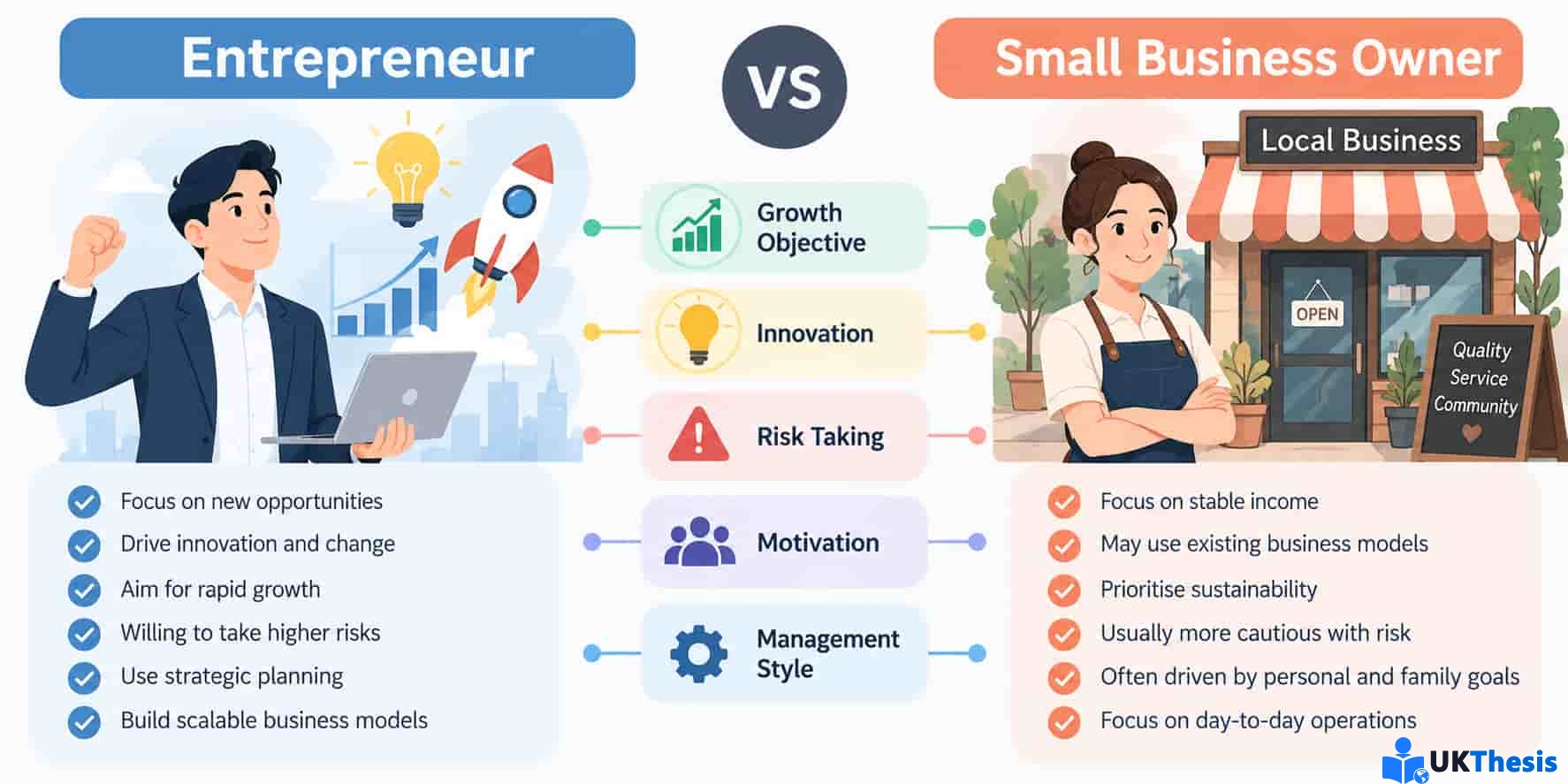
这篇Essay讨论的重点,就是Entrepreneur和Small Business Owner到底有什么不同。两者都可能建立并经营自己的企业,也都需要承担Business Risk,但他们在Growth、Innovation、Opportunity、Motivation、Strategic Objectives以及Management Style方面可能存在明显差异。
核心问题:拥有一家企业并不自动等于Entrepreneurship。真正需要分析的是:经营者为什么创业、希望企业走多远、如何看待Innovation,以及是否主动创造新的市场机会。
| Comparison | Entrepreneur | Small Business Owner |
|---|---|---|
| Primary Focus | Opportunity and Growth | Income and Business Stability |
| Innovation | Often central | May use established models |
| Growth | Usually seeks expansion | May prioritise sustainability |
| Risk | More willing to accept uncertainty | Often more cautious |
| Strategic Objectives | Market growth and new opportunities | Stable income and local performance |
What Is an Entrepreneur?
An entrepreneur can be understood as an individual who identifies opportunities, creates or develops a venture and manages uncertainty in pursuit of growth or value creation. Profit is important, but entrepreneurship is not defined by profit alone.
Entrepreneurs are often associated with innovation, opportunity recognition and strategic growth. They may create a completely new product, introduce a different way of delivering an existing service, enter a new market or reorganise resources in a way that creates additional value.
The important point is that an entrepreneur is usually looking beyond the simple maintenance of an existing business. The venture is often connected with a desire to grow, change or create something that did not previously exist in the same form.
What Is a Small Business Owner?
A Small Business Owner may also establish and manage a business, but the purpose of the business can be different. For many owners, the business provides income, independence and personal stability rather than rapid expansion.
The business may also be closely connected with the owner’s personal and family goals. A local restaurant, neighbourhood shop, independent service provider or family business may be highly successful without attempting to become a national or international company.
That does not make the Small Business Owner less valuable. Small businesses and entrepreneurial ventures simply perform different functions and may pursue different objectives.
Entrepreneur vs Small Business Owner
The distinction becomes clearer when their goals and behaviours are compared.
Entrepreneurs are often motivated by growth and new opportunities. They may use strategic planning, seek new markets and accept uncertainty in order to expand the venture.
Small Business Owners, by contrast, may place greater emphasis on stable income, independence, family priorities or the long-term survival of the business.
However, this distinction should not be treated as an absolute rule. A Small Business Owner can be highly innovative, while some entrepreneurial ventures may eventually become conservative once they mature.
The difference is therefore better understood as a pattern rather than a rigid definition.
Characteristics of Entrepreneurs
Research into entrepreneurship has identified several attitudes and behaviours commonly associated with entrepreneurs. These include:
commitment and determination;
need for achievement;
internal locus of control;
opportunity orientation;
creativity and innovation.
这些Characteristics看起来很熟悉,但写Essay时不要简单把它们当成“成功人士性格大全”。最重要的是解释这些Characteristics为什么可能影响Business Behaviour。
For example, an opportunity-oriented entrepreneur may spend more time searching for new products or markets, while someone with a strong internal locus of control may be more willing to believe that personal decisions can influence outcomes.
Entrepreneurial Venture vs Small Business Venture
An Entrepreneurial Venture is commonly associated with three broad features: Innovation、Growth Potential和Strategic Objectives。
| Feature | Entrepreneurial Venture | Small Business Venture |
|---|---|---|
| Innovation | Creates or applies new ideas | Often operates established business models |
| Growth Potential | May target large or new markets | Growth may be limited by local market size |
| Strategic Objectives | Growth, market development and expansion | Income, stability and operational performance |
Innovation and Creativity
Innovation is one of the clearest characteristics commonly linked with entrepreneurial ventures.
An entrepreneur may introduce a new technology, create a new service, redesign how a product is distributed or develop a different organisational model. Innovation therefore does not always mean inventing an entirely new product.
Small businesses may also innovate, but many operate successfully by offering established products or services within a particular local market.
This is where the difference between being “new” and being “innovative” becomes useful. A newly opened local café is a new business, but unless it introduces something meaningfully different, it is not automatically an entrepreneurial innovation.
Growth Potential and Strategic Objectives
Entrepreneurial Ventures are frequently associated with stronger growth ambitions. Growth may involve new markets, new products, additional locations or completely new industries.
Strategic objectives can include:
growth targets;
market development;
market share;
new customer segments;
new products or services.
A Small Business Owner may also have growth targets, but growth is not necessarily the dominant objective. A profitable independent business can remain relatively small for many years and still meet the owner’s goals.
Risk Taking and Opportunity Orientation
Entrepreneurs are often described as risk takers, but this phrase is easy to misunderstand.
Successful entrepreneurship does not simply mean choosing the highest-risk option available. Effective entrepreneurs normally evaluate uncertainty and accept risk when they believe the potential opportunity justifies it.
Opportunity Orientation is therefore more useful than describing entrepreneurs as people who simply “love risk”. Entrepreneurs may expose resources to uncertainty because they believe an opportunity can create future value.
Small Business Owners may behave more cautiously because protecting existing income and resources can be more important than pursuing rapid expansion.
Entrepreneurial Motivation
Motivation helps explain why two people facing similar business opportunities may behave very differently.
Entrepreneurs may be motivated by growth, independence, achievement, opportunity, creativity or the desire to build something new. Small Business Owners may place relatively greater emphasis on independence, income, personal status, family priorities and stability.
However, motivation varies greatly between individuals. It is therefore risky to claim that all entrepreneurs are motivated by one psychological need.
Maslow and Entrepreneurial Motivation
Maslow’s Hierarchy of Needs has sometimes been used to explain entrepreneurial motivation. The theory suggests that human needs can be considered across levels including physiological needs, security, social needs, esteem and self-actualisation.
An entrepreneur pursuing growth, creativity or personal fulfilment may appear to demonstrate self-actualisation needs, while a Small Business Owner may place stronger emphasis on financial security, independence or esteem.
But this interpretation should not be treated too mechanically.
People can pursue more than one type of need at the same time. An entrepreneur might seek financial security, reputation and personal fulfilment simultaneously.
学姐提醒:理论模型千万不要写成星座分析。不是“Entrepreneur = Self-Actualisation,Small Business Owner = Esteem”就结束了。真正的Critical Analysis应该继续问:现实中的经营者会不会同时有Financial、Status和Growth Motivation?答案通常是会。
McClelland and Need for Achievement
McClelland’s Achievement Motivation theory is particularly relevant to entrepreneurship because it focuses on the desire to achieve challenging goals and perform against personal standards.
Entrepreneurs are often associated with a relatively strong need for achievement because they may set challenging objectives and take personal responsibility for results.
However, Need for Achievement alone cannot reliably explain who becomes an entrepreneur. Business Environment、Personal Goals、Opportunity、Resources和Experience也会影响创业行为。
This is important because entrepreneurial behaviour should not be reduced to personality alone.
Internal Locus of Control
Another commonly discussed characteristic is Internal Locus of Control.
People with a strong Internal Locus of Control tend to believe that their actions can influence outcomes. In an entrepreneurial context, this may encourage individuals to take responsibility, search for opportunities and respond actively to problems.
Again, this does not mean every successful entrepreneur possesses the same personality profile. Entrepreneurial behaviour can result from the interaction between individual characteristics and the wider business environment.
The Dark Side of Entrepreneurship
Entrepreneurship is often described positively through words such as Innovation、Vision和Risk Taking. A stronger Essay should also examine possible limitations.
A strong need for control can become micromanagement. Confidence can turn into overconfidence. Rapid decision making may sometimes lead to errors, while a constant focus on opportunity can create excessive pressure on resources and employees.
This is why entrepreneurial characteristics should not automatically be described as positive.
| Entrepreneurial Trait | Possible Strength | Possible Limitation |
|---|---|---|
| Confidence | Supports decisive action | Can become overconfidence |
| Need for Control | Maintains direction | May reduce delegation |
| Risk Taking | Allows new opportunities | Can expose resources to loss |
| Fast Decision Making | Supports agility | May reduce accuracy |
Entrepreneurial Management
Entrepreneurial Management focuses on opportunity, change and organisation-wide growth.
Entrepreneurs often need to coordinate people, resources, money and ideas while operating under uncertainty. Their role therefore goes beyond creating the initial business idea.
As a venture grows, the entrepreneur may need to move from personally controlling every detail toward building systems, delegating responsibility and developing leadership capability.
This transition can be difficult. Creativity may help start a venture, but creativity alone does not manage a larger organisation.
Management Style
Different entrepreneurs may adopt very different Management Styles.
Some founders prefer strong personal control and centralised decisions. Others rely more heavily on employee participation, professional managers or decentralised leadership.
There is therefore no single “entrepreneurial management style”. The appropriate approach may depend on the stage of business growth, size of the team, industry and personality of the founder.
A founder who controls every decision during the first year may eventually need to delegate as the company grows. Otherwise, the entrepreneur can become the main bottleneck in the organisation.
A More Balanced Comparison
The distinction between Entrepreneurs and Small Business Owners is useful, but it should not become a stereotype.
Not every entrepreneur seeks extreme growth. Not every Small Business Owner avoids innovation. A local family business may innovate substantially, while a rapidly growing venture may eventually become focused on protecting its existing market.
It is therefore better to compare them through several dimensions rather than relying on one definition.
| Dimension | Entrepreneurial Orientation | Small Business Orientation |
|---|---|---|
| Opportunity | Actively searches for new opportunities | Focuses on existing market |
| Innovation | Often important | May or may not be important |
| Growth | Usually stronger ambition | May prioritise sustainability |
| Resources | Uses resources to pursue opportunities | Protects scarce resources |
| Management | Strategic and opportunity-driven | Operational and stability-driven |
Conclusion
Entrepreneurs and Small Business Owners share several characteristics because both establish and manage businesses, take responsibility for resources and operate under uncertainty.
However, important differences can appear in their goals, attitudes toward growth, Innovation、Opportunity Orientation、Risk、Motivation和Management Style.
Entrepreneurs are more commonly associated with growth, opportunity, innovation and Strategic Objectives, while Small Business Owners may place relatively greater emphasis on income, independence, local performance and stability.
At the same time, these differences should not be treated as rigid categories. Entrepreneurs are not all identical, and Small Business Owners are not automatically conservative or non-innovative.
The most useful conclusion is therefore that Entrepreneurship describes a particular orientation toward opportunity and value creation rather than simply the legal fact of owning a business.
学姐的写作提醒:Entrepreneur和Small Business Owner这种Comparison Essay最容易犯的毛病,就是左边写10条、右边写10条,然后宣布“they are different”。真正有分数的地方在后面那个“为什么”。为什么Growth Orientation会改变Risk Decision?为什么Innovation会改变Management Practice?为什么一个Founder在公司变大以后必须学会Delegation?多追问一次,Essay的Critical Analysis就出来了。
FAQ
Q1:Entrepreneur和Small Business Owner是同一个概念吗?
不完全相同。两者都可能拥有企业,但Entrepreneurship通常更强调Opportunity、Innovation、Growth和Value Creation。
Q2:Small Business Owner就一定不创新吗?
不是。很多Small Businesses也会创新。区别更多体现在Innovation和Growth是否成为企业主要战略方向,而不是简单判断“谁会创新”。
Q3:Entrepreneur一定比Small Business Owner更喜欢Risk吗?
不能这么绝对。Entrepreneurs通常更愿意面对Uncertainty,但有效创业并不是盲目追求高风险,而是判断Risk和Opportunity之间的关系。
Q4:Entrepreneurial Motivation可以用Maslow分析吗?
可以作为一个理论视角,但不要机械地把Entrepreneur全部放进Self-Actualisation。现实中的Motivation往往同时受到Income、Achievement、Independence、Status和Personal Goals影响。
Q5:McClelland为什么常用于Entrepreneurship Essay?
因为Need for Achievement可以帮助解释为什么部分Entrepreneurs愿意设定具有挑战性的目标,但它不能单独预测创业行为。
Q6:Entrepreneurial Management和普通Management有什么不同?
Entrepreneurial Management通常更强调Opportunity、Change、Innovation和Growth,但随着企业规模扩大,也需要越来越多Formal Management和Delegation。
Q7:Entrepreneurship Assignment怎么写得更Critical?
除了比较Differences,还要讨论Exceptions和Limitations。例如不是所有Entrepreneurs都高风险,也不是所有Small Business Owners都缺乏Innovation。如果在Essay Structure、Theory Application或Critical Analysis上卡住,可以通过UKThesis的Essay辅导梳理整体论证结构。
相关阅读
如果正在写Business、Management或Entrepreneurship课程作业,可以继续阅读站内关于Strategic Management、Leadership、Motivation以及Business case study的相关文章。建议内链优先选择与Growth、Innovation、Decision Making和Management Style真正相关的页面,而不是因为都属于Business就机械互链。