Entrepreneurship Literature Review范文|小企业创业困难与挑战分析

Entrepreneurship一直是Business Management、Small Business Management以及Dissertation研究中比较常见的主题。创业听起来很热血,真正开始做以后才会发现,困难往往不是“有没有好点子”这么简单。融资、市场、人员、管理能力、实施过程以及有限资源,都可能决定一家小企业能不能撑过最初几年。
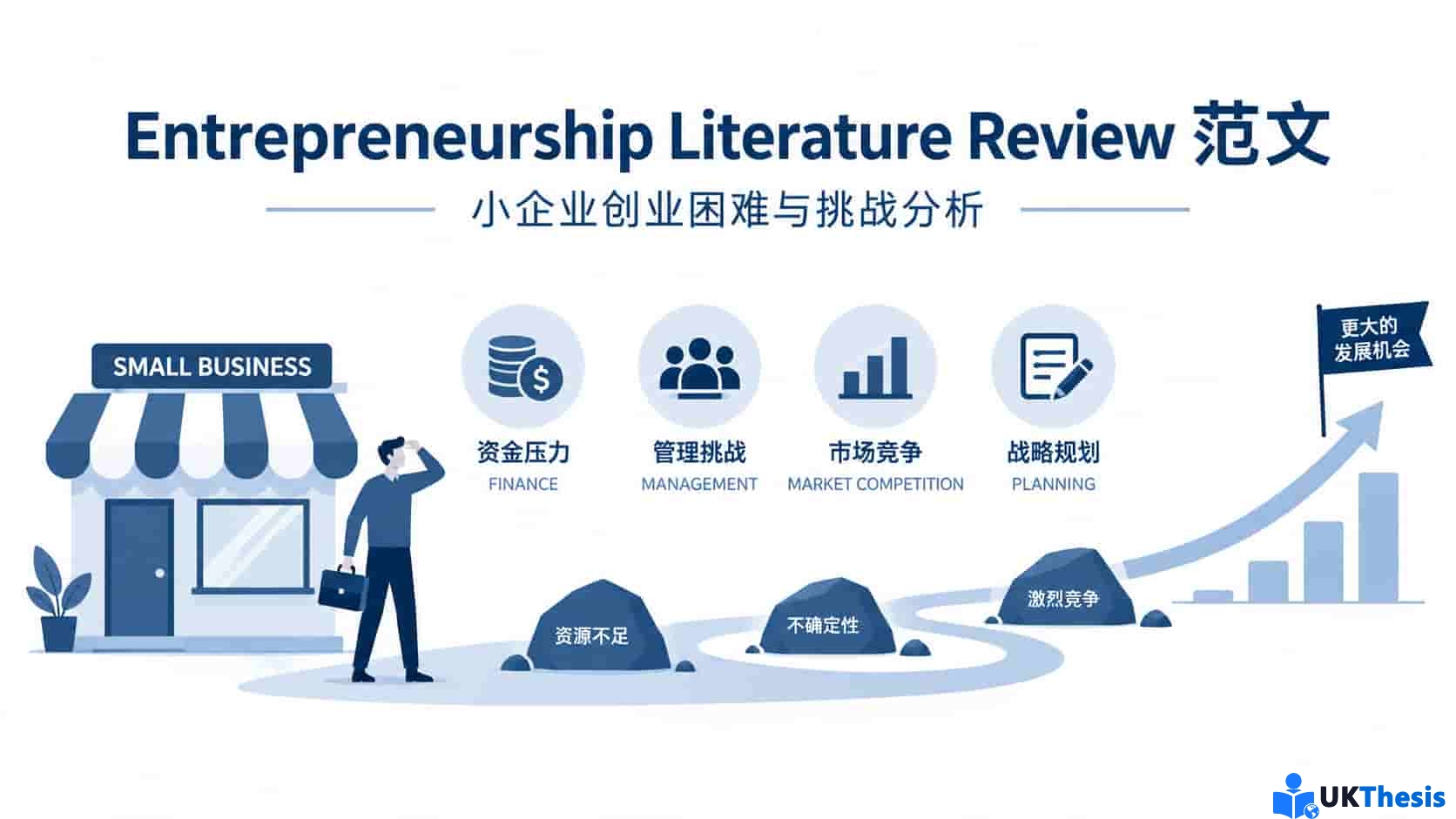
下面这篇Entrepreneurship literature review主要围绕Small Business在创业过程中遇到的困难和挑战展开。作为文献综述范文,它比较适合参考的地方,是把创业问题拆成了几个相互关联的主题,而不是单纯把不同作者的观点一个一个罗列出来。
范文类型:Literature Review / Dissertation Literature Review
专业方向:Entrepreneurship / Business Management / Small Business
核心问题:创业初期困难、融资、管理能力、市场进入、人力资源与实施挑战
research Questions
这篇Literature Review主要围绕三个问题展开:
Why do small businesses encounter so many difficulties at the start-up stage?
What are the major problems influencing small firms in entrepreneurship?
Is it important to acquire entrepreneurial skills before starting a small business?
这几个问题看起来简单,但其实已经把研究范围限制得比较清楚:重点不是“大企业如何成长”,而是Small Business在创业初期为什么容易失败,以及创业能力是否能够降低风险。
Research Objectives
The main objectives of the literature review are:
to identify entrepreneurial ideas and opportunities discussed in previous studies;
to examine the role of business planning in overcoming start-up problems;
to analyse the barriers that may restrict entrepreneurial creativity and business development.
Introduction:为什么Small Business更容易遇到挑战?
Evidence suggests that small businesses generally face greater uncertainty than large organisations. Some survive and grow, while others disappear relatively quickly. Previous studies have linked these differences to factors such as economies of scale, human capital, access to resources, geographical location and management skills.
In an increasingly competitive and globalised economy, good management becomes particularly important for smaller firms. Large companies may have specialised departments for finance, marketing, human resources and legal issues. A small business owner, however, may suddenly discover that one person is expected to understand all of them.
这也是我觉得创业类Literature Review很有意思的地方。表面上看大家都在谈“entrepreneurial spirit”,真正读文献以后会发现,大量研究其实讨论的是非常现实的问题:钱从哪里来、人怎么管、客户怎么找、风险怎么控制。
What Is Entrepreneurship?
An entrepreneur is generally understood as an individual who establishes or develops a new venture and accepts responsibility for its risks and outcomes. Earlier literature also emphasises the entrepreneur's role in recognising opportunities, organising resources and creating economic value.
Entrepreneurship therefore involves more than simply opening a business. It normally includes opportunity recognition, innovation, planning, resource allocation, risk management and the ability to respond to changing market conditions.
For a new business, one of the first challenges is persuading customers to try an unfamiliar product or service. Established brands already benefit from recognition and habitual purchasing behaviour, while new firms often need to spend considerable effort building trust.
Major Problems and Challenges in Entrepreneurship
Entrepreneurs have become an important force in modern economies, but the process of creating and developing a business remains uncertain.
Several recurring challenges appear in the literature:
| Challenge | Why it matters |
|---|---|
| Finance | New businesses often need capital before they can generate stable revenue. |
| Management skills | Founders may understand their product but lack experience in finance, HR or operations. |
| Marketing | New firms must persuade customers to trust an unfamiliar brand. |
| Human resources | Small firms may not be able to hire specialists for every function. |
| Limited resources | Time, money and professional support are usually more restricted than in large firms. |
Finance is one of the most obvious difficulties. Unless the entrepreneur can fund the venture personally, external capital may be needed. This means preparing financial forecasts, considering loans and estimating how long the business may operate before reaching profitability.
At the same time, financial resources alone cannot solve every problem. A business may have enough money to begin but still struggle because the owner lacks the knowledge required to manage growth.
Implementation Stage:真正难的是把计划做出来
A good business plan is important, but implementation is often the point at which entrepreneurial ideas succeed or fail.
During the implementation stage, entrepreneurs may need to deal with marketing, sales, employees, public relations, legal requirements, government regulations, risk management, insurance, technology and financial records at the same time.
For a small organisation, expecting one person to master every area is unrealistic. Successful entrepreneurs therefore need to recognise the limits of their own expertise and identify areas where external advice or specialist support is necessary.
Literature Review写作提示:
这里不要只写“创业者需要很多技能”。更好的写法是比较不同研究关注哪些能力:有的强调financial planning,有的强调marketing capability,还有研究关注human capital或leadership。这样才会形成真正的Synthesis。
Critical Challenge 1:Start-up Finance
Many businesses can begin on relatively small budgets, but most still require access to capital at some stage. The key issue is not only where the money comes from, but whether entrepreneurs estimate start-up costs realistically and manage available funds effectively.
New entrepreneurs may underestimate how long it takes before a business becomes profitable. This can create a gap between expected and actual cash flow.
A realistic financial plan can therefore reduce uncertainty by identifying costs, funding requirements and potential financial pressure before those problems become critical.
Critical Challenge 2:Management and Human Capital
At the early stage of a venture, entrepreneurs often become responsible for almost everything, from product development and customer acquisition to accounting and administration.
This creates a clear human-capital problem. A founder may have strong technical knowledge but limited marketing experience, or understand sales but have little knowledge of employment law and financial management.
Entrepreneurial success therefore depends partly on recognising where these gaps exist.
从学生写作角度看,这一点也很适合做Critical Analysis。不能简单说“skills are important”,而应该继续问:究竟是founder's individual skills更重要,还是企业能够获得外部expertise更重要?不同文献对此可能会有不同答案。
Critical Challenge 3:Market Entry and Customer Acceptance
New firms frequently compete against established businesses that already possess brand recognition and loyal customers.
Consumers can be cautious when trying unfamiliar products or services. Small firms must therefore develop appropriate marketing strategies while often working with much smaller promotional budgets.
This creates a difficult balance. A new business needs visibility, but excessive marketing expenditure can place additional pressure on limited financial resources.
For this reason, the first customer experience can become particularly important. Negative early experiences can damage reputation before a new brand has established itself.
Critical Challenge 4:Time and Workload
Entrepreneurs often invest considerable amounts of personal time in their businesses.
At the beginning, work is rarely divided neatly into separate job descriptions. One person may move between sales, customer service, administration and financial management in the same day.
Clear goals, realistic scheduling and prioritisation can therefore become important management tools. However, the literature also suggests that workload problems are connected to wider issues such as resource limitations and lack of specialist staff.
创业挑战可以怎样分类?
| Dimension | Typical problems |
|---|---|
| Financial | Start-up capital, cash flow, cost estimation, access to finance |
| Managerial | Planning, leadership, decision-making and lack of specialist knowledge |
| Market | Brand awareness, customer trust, competition and marketing cost |
| Human Capital | Skills gaps, recruitment and limited staff capacity |
| Operational | Implementation, regulation, risk and daily workload |
How Can Entrepreneurs Respond to These Challenges?
There is no single solution to every entrepreneurial difficulty.
However, previous research suggests several practical responses. Training programmes, professional networks, industry associations and external advisers can help entrepreneurs compensate for gaps in their own expertise.
Planning is also important, particularly where finance and implementation are concerned. The purpose of planning is not to predict everything perfectly, but to make risks visible before they become impossible to manage.
Entrepreneurs also need enough flexibility to change direction when market conditions, customer expectations or available resources change.
Literature Review Conclusion
The literature suggests that small-business entrepreneurship is influenced by a combination of financial, managerial, human and market-related challenges.
Access to capital remains important, but finance alone does not guarantee success. Entrepreneurs also require planning skills, management capability, market awareness and the ability to recognise when external expertise is needed.
Small firms may be especially vulnerable because their resources are limited and individual founders often carry responsibility for several business functions simultaneously.
From a Literature Review perspective, these findings suggest that entrepreneurship should not be explained through one single factor. Financing, human capital, marketing and management capability interact with each other throughout the start-up and implementation stages.
因此,如果把这篇内容用于Business Dissertation,后续研究可以继续从一个更具体的Research Gap切入,比如:创业教育是否真的能够提高Small Business survival、管理能力和融资能力之间是否存在关系,或者不同地区的小企业面临的障碍是否存在明显差异。
FAQ
Q:这篇属于essay还是Literature Review?
A:更准确地说属于Entrepreneurship Literature Review,也可以作为Business Dissertation中的Literature Review Chapter参考。
Q:Entrepreneurship Literature Review应该重点写什么?
A:不要只介绍“什么是创业”。更重要的是围绕Research Question整理已有研究,比如融资、Entrepreneurial Skills、Human Capital、Innovation、Market Entry和Business Survival。
Q:Literature Review是否应该一个作者写一段?
A:一般不建议。更好的方法是按照主题组织,例如Finance、Management Skills、Human Capital和Marketing,然后在同一主题下比较不同研究的观点。
Q:这类主题适合继续写Dissertation吗?
A:适合,但最好进一步缩小范围。比如研究UK SMEs、International Students Entrepreneurship、Female Entrepreneurs、Digital Entrepreneurship或Entrepreneurial Education,会比泛泛研究“创业困难”更容易形成清晰的Research Question。
相关阅读
如果还不熟悉文献综述的基本结构,可以阅读:Literature Review怎么写?高分文献综述格式与写作指南。
如果正在准备Business Dissertation,可以继续阅读:Master's Thesis与Dissertation写作指南。
对于已经有Research Question或初稿的同学,也可以通过Literature Review结构辅导、文献筛选、Critical Analysis、语言修改和dissertation写作支持,把已有材料重新整理得更清楚,而不是单纯增加引用数量。
```