Game Theory Essay范文:历史、Nash Equilibrium、博弈类型与经济学应用

Game Theory刚开始学的时候,很容易被名字骗到,以为它是在研究“游戏怎么玩”。真正到了Economics课程里才会发现,它研究的核心其实是:当你的结果不仅取决于自己,还取决于别人怎么选择时,你应该怎样做Decision。
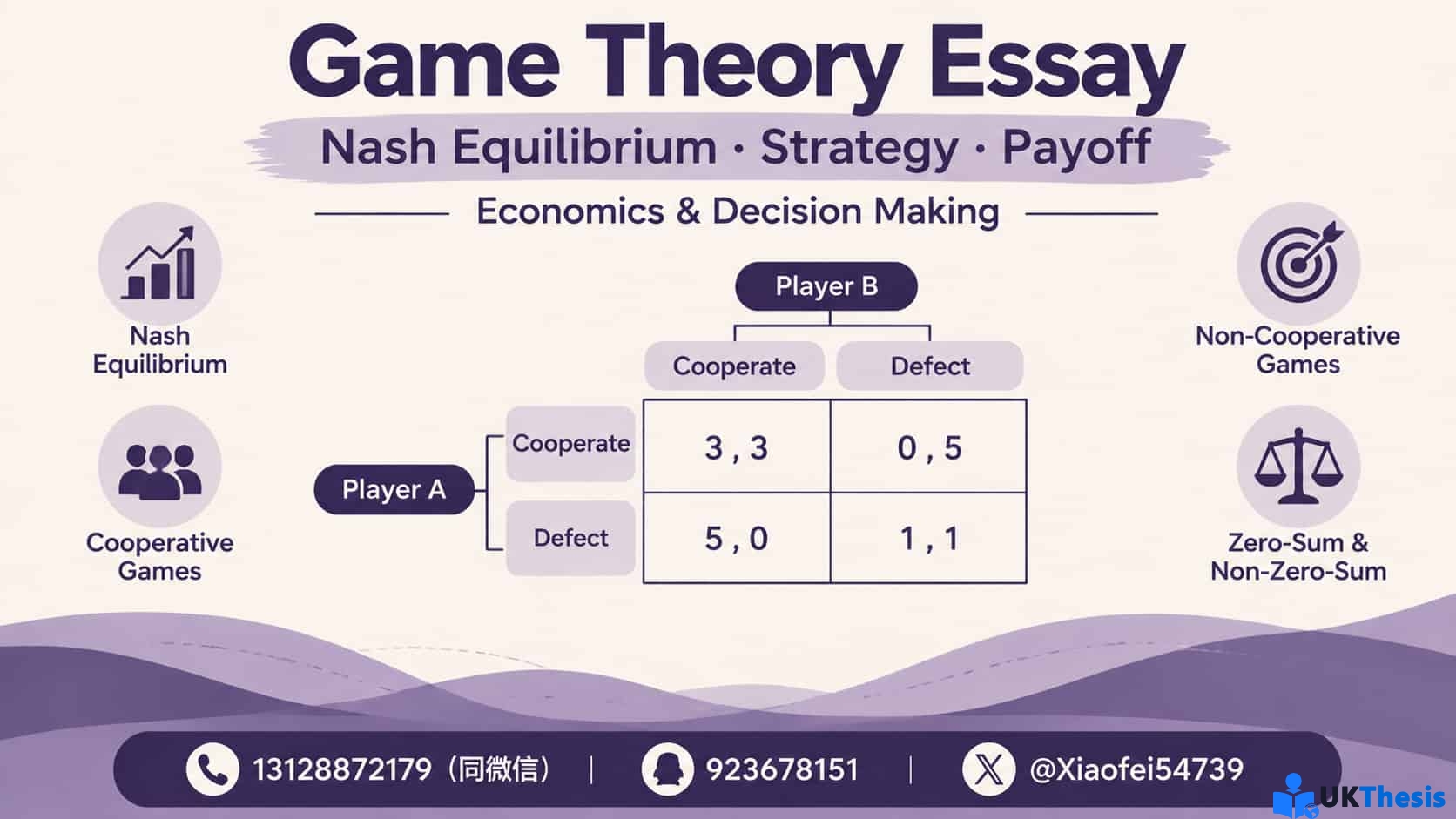
企业定价、市场竞争、谈判、政治策略、拍卖甚至社交网络,都可能用到Game Theory。下面这篇essay从博弈论的历史、Nash Equilibrium、不同Game Types以及实际应用展开,适合Economics assignment或Game Theory Essay作为结构参考。
What Is Game Theory?
Game theory is a mathematical framework used to analyse situations in which the outcome for one participant depends not only on that participant's own decision, but also on the decisions made by others.
It is widely used in economics, political science, operations research, computer science and other fields that involve strategic interaction.
In a simple market example, one company may decide whether to lower its price. The final result depends not only on its own decision, but also on how competitors respond.
| Core Element | Meaning |
|---|---|
| Players | 参与决策的individuals、firms或countries |
| Strategies | 每个player可以选择的行动 |
| Payoffs | 不同strategy combination产生的结果 |
| Equilibrium | 没有player愿意单方面改变strategy的状态 |
A Brief History of Game Theory
Ideas related to strategic interaction appeared long before modern economics formally defined game theory.
Early mathematical discussions of strategic choice can be traced to work on card games, chess and probability. During the nineteenth century, economists also began using mathematical models to analyse competition and strategic interaction.
A major turning point came in the twentieth century. John von Neumann developed important mathematical foundations for game theory, and together with Oskar Morgenstern published Theory of Games and Economic Behavior in 1944.
This work helped establish game theory as a distinct field of study.
John Nash later made another major contribution through his work on non-cooperative games and equilibrium. The concept now known as the Nash Equilibrium became one of the most important tools in modern game theory.
学姐看这里:写Game Theory Essay时,不要把History写成“某年某人干了什么”的流水账。更有用的是解释:这些理论为什么重要,它们到底改变了Economics怎样分析strategic behaviour。
Nash Equilibrium
A Nash Equilibrium occurs when each player has selected a strategy and no player can improve their outcome by changing strategy alone while the strategies of other players remain unchanged.
这个概念看起来有点抽象,其实用企业竞争来理解会简单很多。
假设两个firms都在决定是否降价。如果A降价而B不降,A可能获得更多customers;但如果两家都降价,双方利润都可能下降。
最后形成的strategy combination如果满足“任何一家公司单独改变选择都不会变得更好”,就可能构成Nash Equilibrium。
重要的是,Equilibrium并不意味着结果一定“最好”。它只表示在当前strategies下,没有player有动力单方面偏离。
Cooperative and Non-Cooperative Games
Game theory often distinguishes between cooperative and non-cooperative games.
In a cooperative game, players may form coalitions or agreements and coordinate their strategies.
In a non-cooperative game, each player makes strategic decisions independently according to their own incentives.
| Type | Key Feature | Example |
|---|---|---|
| Cooperative Game | 允许players协调或形成coalition | Joint venture、coalition bargaining |
| Non-Cooperative Game | players独立选择strategy | Firm pricing、market competition |
Symmetric and Asymmetric Games
In a symmetric game, the identity of the players does not fundamentally change the strategic structure of the game.
The same strategies and payoff relationships apply regardless of which player occupies a particular position.
In an asymmetric game, players may have different resources, roles, strategies or payoff structures.
This distinction matters because real-world economic competition is often asymmetric. A large incumbent firm and a small new entrant, for example, may face very different incentives even when competing in the same market.
Zero-Sum and Non-Zero-Sum Games
In a zero-sum game, one player's gain is exactly matched by another player's loss.
The total payoff across players therefore remains constant.
However, many economic situations are non-zero-sum.
Two firms may compete while still expanding the total market. Two countries may negotiate a trade agreement from which both gain. A bargaining outcome may also leave both participants better off than if no agreement were reached.
| Game Type | Basic Logic |
|---|---|
| Zero-Sum | One player's gain = another player's loss |
| Non-Zero-Sum | Total payoff can increase or decrease |
Repeated Games
Repeated games examine what happens when players interact more than once.
This is particularly important in economics because firms, governments and individuals rarely make strategic decisions only once.
A company that competes with the same rival year after year may behave differently from a company facing a one-time interaction.
Reputation, punishment, cooperation and trust can therefore become much more important in repeated games.
This is one reason repeated-game theory has become useful for analysing long-term competition and cooperation.
Applications of Game Theory in Economics
Economics is one of the main areas in which game theory is applied.
Traditional economic models often examine how firms and consumers respond to prices, costs and incentives. Game theory adds another layer by explicitly considering strategic reactions.
For example, an oligopoly firm cannot decide its price without considering how competitors may react.
| Application | Game Theory Question |
|---|---|
| Oligopoly | Competitors如何回应price或output变化? |
| Bargaining | 双方怎样分配surplus? |
| Auctions | Bidders怎样根据其他人的strategy决定bid? |
| Public Goods | 为什么会出现free-rider problem? |
| International Relations | Countries怎样回应彼此的policy choices? |
Game Theory and Social Networks
Game theory has also been applied to social networks.
A network provides a mathematical structure for analysing how people, firms or institutions interact.
Researchers can examine both games played on existing networks and strategic decisions concerning the formation of networks themselves.
This expands game theory beyond traditional market competition and allows researchers to study information diffusion, cooperation and strategic behaviour in connected systems.
Limitations of Classical Game Theory
One major criticism is that real people do not always behave according to strict rational-choice assumptions.
Individuals may be influenced by emotion, incomplete information, behavioural biases and social norms.
This does not make classical game theory useless. Instead, it means that equilibrium models can often be treated as a benchmark rather than a perfect description of human behaviour.
Behavioural economics, Prospect Theory and evolutionary game theory have all contributed to broader approaches for analysing situations in which actual decisions differ from simple rational-choice predictions.
写作观察:这一段特别适合拿来做Critical Evaluation。Game Theory Essay如果只有Definition和Game Types,会像教材摘要;加上rationality assumption、behavioural limitations和out-of-equilibrium dynamics,才开始有Academic Analysis的感觉。
Conclusion
Game theory provides a powerful framework for analysing strategic interaction.
Its development from early mathematical work to von Neumann, Morgenstern and Nash transformed the way economists study competition, bargaining and decision-making.
Concepts such as Nash Equilibrium, cooperative and non-cooperative games, symmetric and asymmetric games, and zero-sum and non-zero-sum games remain central to the field.
At the same time, game theory is not limited to economics. It is also used in political science, social networks, operations research and computer science.
The most important limitation is that real-world behaviour does not always conform to strict rationality assumptions. For this reason, modern applications increasingly combine classical game theory with behavioural and dynamic approaches.
这篇Game Theory Essay最值得学什么?
| Section | Academic Function |
|---|---|
| History | 交代理论发展 |
| Nash Equilibrium | 解释核心理论概念 |
| Game Types | 建立理论分类框架 |
| Applications | 连接现实Economics问题 |
| Limitations | 形成Critical Evaluation |
第一次学Game Theory时,很容易把它背成“zero-sum、Nash equilibrium、cooperative game”三个Definition。
真正到了Essay里,最好继续问一句:这个模型到底解释了什么现实行为?它的assumptions又限制了什么?
这两句话一出来,文章通常就比单纯教材式总结更像大学Economics Essay。
FAQ
Game Theory属于Economics Essay吗?
通常可以。尤其是题目涉及oligopoly、strategic competition、bargaining、auctions或decision-making时,非常适合归入Economics Essay或Mathematical Economics。
Game Theory和Finance是一回事吗?
不是。Game Theory主要研究strategic interaction。它可以用于Finance,但本身更常见于Economics、Political Science、Business Strategy和Decision Theory。
Nash Equilibrium是不是最佳结果?
不一定。Nash Equilibrium表示没有player愿意单方面改变strategy,并不保证这个结果对所有人来说都是最优或者最有效率。
Zero-Sum Game是不是所有竞争市场?
不是。很多经济活动属于non-zero-sum,因为双方都有可能获益,也可能同时受损。Zero-sum只是Game Theory中的一种特殊结构。
Game Theory Essay不会写怎么办?
可以先按照Concept、Model、Example、Application和Limitation几个部分整理。如果题目比较复杂,也可以通过Economics Essay写作辅导先确定Question、Structure和Economic Logic,再进入正式写作。
相关文章阅读
Game Theory最有意思的地方其实不是公式,而是它逼着你承认一个现实:很多时候,你的“最佳选择”根本不由你一个人决定。