McDonald’s Strategic Management Essay范文:Leadership与Decision Making案例分析

Strategic Management和Leadership在Business、Management课程里经常一起出现,看起来都是“管理公司”,真正写assignment时却很容易混在一起。一个比较简单的理解是:Strategic Management更多回答企业准备往哪里走、为什么这样走以及如何配置资源;Leadership则进一步涉及谁来推动这些决定,以及怎样让组织中的人真正参与执行。
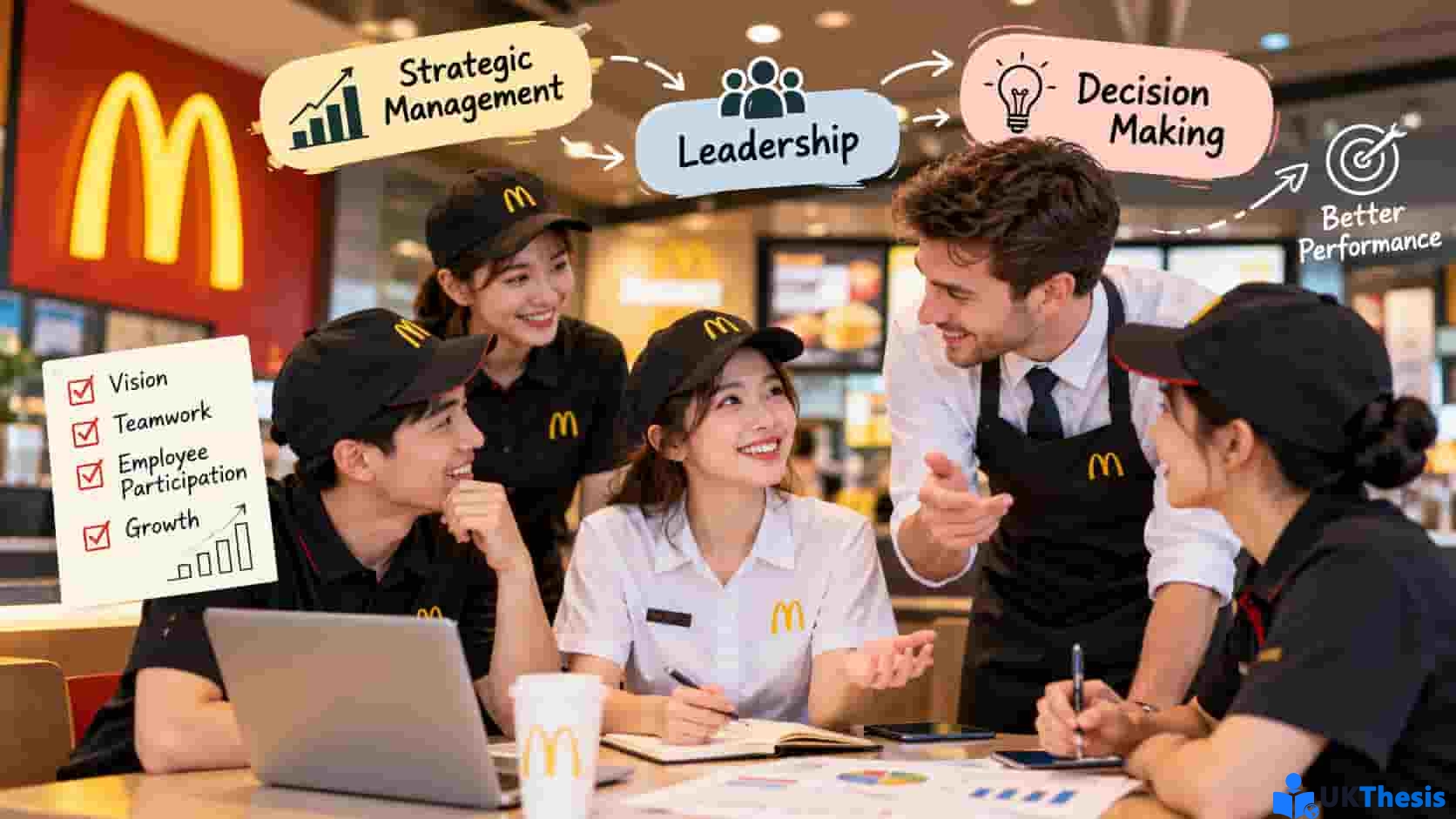
这篇Academic essay以McDonald’s为案例,讨论Strategic Management、Leadership与Decision Making之间的关系。文章特别关注不同领导方式如何影响员工参与、沟通、工作安排以及战略决策。原案例中还包含作者在McDonald’s工作期间形成的一些观察,因此阅读时需要区分personal workplace observation和可以推广到整个企业的结论。
这篇Essay的核心问题:Strategic Management决定组织的方向以后,Leadership如何把战略真正转化为Decision Making和员工行动?
| 分析维度 | 核心问题 | McDonald’s案例应用 |
|---|---|---|
| Strategic Management | Where is the organisation going? | 目标、资源与长期方向 |
| Leadership | How are people influenced and coordinated? | 经理与员工之间的沟通和参与 |
| Decision Making | How are choices translated into action? | 任务分配、反馈与运营决定 |
| Employee Participation | Who contributes to decisions? | 一线员工参与、意见反馈与团队合作 |
Strategic Management and Leadership
This academic essay is related to strategic management and leadership in McDonald’s. The purpose of the assignment is to understand the impact of decision making within an organisation and to consider how leadership and proactive strategy may contribute to organisational success.
Strategic management entails both strategic planning and implementation. In practical terms, it provides an overall direction for the organisation. This may involve specifying the organisation’s mission, vision and objectives, developing plans and considering how available capabilities can be matched with the demands of the external environment.
Leadership, meanwhile, concerns influence. It involves the process through which people are encouraged and coordinated toward the achievement of organisational objectives. Leadership should not be reduced simply to charisma. Good judgement, employee motivation, communication and effective use of organisational resources can all influence whether a strategy works in practice.
That is why Strategic Management and Leadership need to operate alongside one another. A strategy written beautifully in a PowerPoint presentation does not automatically become organisational performance. Someone still has to communicate it, allocate responsibilities, listen to feedback and make decisions when reality refuses to behave exactly as the plan predicted.
The Link Between Strategic Management and Leadership
Organisations operate in changing environments and often face pressure to produce immediate results while still protecting long-term objectives. Strategic management is therefore concerned not only with choosing objectives but also with determining how organisational resources can be used to achieve them.
Strategic leadership adds the human side of this process. Leaders need to understand current business conditions while also taking responsibility for the future. They must identify changing situations, communicate priorities and help employees understand what a strategic decision means for their own work.
Leadership styles may also change according to circumstances. Autocratic, democratic, participative and other approaches are not simply labels to memorise for an exam. The more useful Assignment question is whether a particular leadership approach fits the decision, the people involved and the organisational situation.
| Strategic Management | Leadership | Connection |
|---|---|---|
| Sets direction | Communicates direction | Strategy becomes understandable |
| Allocates resources | Coordinates people | Resources become actions |
| Responds to environment | Responds to people and situations | Organisation becomes adaptable |
| Defines objectives | Motivates employees | Objectives become executable |
Leadership Style and Decision Making at McDonald’s
McDonald’s provides an interesting company case because restaurant operations require both consistency and everyday decision making. Managers need to maintain operating procedures while dealing with employees, customers, schedules, workloads and unexpected situations.
Based on my own experience of working within the company, I observed a relatively participative management approach in the workplace around me. Employees could contribute ideas and managers could receive feedback from people involved in day-to-day operations. I found this especially noticeable when working arrangements or practical problems required adjustment.
This observation should not be interpreted as evidence that every McDonald’s restaurant in every country follows one identical democratic leadership model. McDonald’s is a large international system, and management practices can differ according to restaurant ownership, managers, local working cultures and circumstances. Nevertheless, the workplace experience provides a useful case for discussing participative decision making.
Within the environment I observed, the gap between managers and employees was relatively limited and communication often worked in both directions. Managers retained responsibility for running the restaurant, while employees could still provide ideas and practical feedback.
This matters because frontline employees frequently possess information that senior decision makers do not see immediately. They interact with customers, equipment, schedules and operational processes every day. Employee participation can therefore do more than make staff “feel included”; it can provide managers with information relevant to operational decisions.
写Management case study时很实用的一步:不要只写“democratic leadership is good”。继续追问:员工参与以后,到底改变了什么?是Information Flow更快?Motivation更高?Decision Quality改善?还是Manager更容易发现Operational Problems?写到这里,Essay才真正开始分析。
Employees also need to work according to their strengths and contribute to how work is organised within a team. Where ideas can move more freely between employees and managers, discussion may help the group coordinate individual responsibilities with broader organisational objectives.
The original workplace experience also suggested that management attempted to understand employees’ strengths and weaknesses and responded through training and career development opportunities. Flexible scheduling and communication with managers could further affect the relationship between supervisors and employees.
However, participative decision making also has limitations. More voices do not automatically produce a better decision. Different opinions can slow agreement, operational environments sometimes require quick decisions, and managers remain accountable for outcomes. A balanced analysis therefore needs to consider both participation and managerial authority.
Impact of Leadership Style on Strategic Decisions
Effective leadership requires adaptation. Different situations may demand different levels of consultation, delegation and managerial control. A participative approach can allow employees to share ideas and feedback, while delegation gives individuals responsibility for particular tasks.
Strategic decisions, however, operate at a different level from everyday operational choices. Senior leaders may determine future objectives and organisational priorities, while restaurant managers and employees translate broader direction into daily activities.
This distinction is particularly useful in a McDonald’s Case Study:
| Decision level | Example | Likely participants |
|---|---|---|
| Strategic | Long-term growth and competitive priorities | Corporate leadership |
| Managerial | Staffing, training and local implementation | Restaurant or functional managers |
| Operational | Work allocation and immediate service problems | Managers and frontline employees |
Seen this way, leadership is not separate from strategic management. Leaders help connect decisions made at different organisational levels. Without this connection, senior management may formulate a sensible strategy that employees cannot translate into everyday action.
A Current Strategic Context
McDonald’s continues to provide a useful strategic management case because the organisation must coordinate decisions across a very large international system. Its current corporate strategy, McDonald’s > NEXT, focuses on the company’s next stage of growth and productivity, while maintaining a strong emphasis on customer experience, operational performance and long-term growth.
For students, current corporate strategy should not replace the original leadership analysis. It is better used as context. The underlying Management question remains surprisingly similar: once a large organisation establishes strategic priorities, how do leaders turn those priorities into decisions that employees and operating units can actually implement?
Conclusion
Strategic management and leadership are closely connected because organisational objectives cannot be achieved through planning alone. Strategic management establishes direction, while leadership influences how people understand, implement and respond to that direction.
The McDonald’s case illustrates how employee participation, communication, delegation and managerial responsibility may interact within decision-making processes. The workplace observations discussed in this Essay suggest that participative practices can help managers obtain feedback and allow employees to contribute practical knowledge. At the same time, participation does not eliminate the need for managerial authority or accountability.
The most useful lesson is therefore not that one leadership style is always superior. Leadership effectiveness depends on the decision, organisational context and people involved. Strategic Management becomes meaningful when organisational direction can be translated into workable decisions, and Leadership is one of the mechanisms through which that translation takes place.
学姐的写作提醒:写McDonald’s、Apple、Amazon这种大公司时,我最怕看到的一句话就是“McDonald’s uses democratic leadership”。一个四五千字Assignment敢用一句话定义整个跨国企业,老师很容易追问:Evidence在哪里?更稳妥的写法是限定范围,例如“in the workplace observed”“at restaurant level”或者“the case suggests”。留一点余地,反而更像真正做过分析的人。
McDonald’s Management Assignment FAQ
Q1:这篇属于Essay还是Case Study?
主体属于Business/Management Academic Essay,同时使用McDonald’s作为Company Case,因此也可以归入McDonald’s Case Study,但不建议把Case Study作为唯一分类。
Q2:Strategic Management和Leadership有什么区别?
Strategic Management主要关注组织方向、目标、资源和竞争环境;Leadership更关注如何影响、协调和带领人实现这些目标。两者在实际组织中往往相互连接。
Q3:可以直接写McDonald’s采用Democratic Leadership吗?
最好不要把局部观察扩大为整个跨国企业的统一管理方式。如果证据来自个人工作经历或单个Restaurant Case,应明确限定分析范围。
Q4:Decision Making为什么适合和Leadership一起分析?
因为Leadership并不只是Motivation。谁参与决定、信息怎样向上传递、任务怎样授权以及Manager什么时候保留最终决定权,都属于领导方式影响Decision Making的具体机制。
Q5:McDonald’s Case Study怎样写出Critical Analysis?
不要停在介绍公司。可以比较Participation的优点与局限,区分Strategic、Managerial和Operational Decisions,再分析不同Leadership Style在不同情况下是否适用。
Q6:Business Assignment不知道怎么把Theory套进Company Case怎么办?
先不要急着堆理论。可以按“Concept → Company Evidence → Why it matters → Limitation”的顺序写。如果在Strategic Management、Leadership Theory、Case Analysis或Essay Structure上卡住,也可以通过UKThesis的Essay辅导进一步梳理论证结构和写作思路。
相关阅读
如果你的Assignment同样选择McDonald’s作为Company Case,可以继续阅读:
McDonald’s Human Resource Management Assignment范文:麦当劳HRM战略案例分析
两篇文章不要混在一起理解。本篇重点是Strategic Management、Leadership和Decision Making;HRM范文则重点分析Recruitment、Training、Motivation和Performance Management。同一个Company Case,用不同理论框架可以形成完全不同的Assignment。