Science Communication Essay范文:Media Hype、Health Misinformation与Public Risk

Science Communication这个题第一次拿到手,很容易写成“媒体很重要、科学也很重要,所以媒体应该正确传播科学”。这话当然没错,但如果一篇大学essay写到最后只有这个结论,老师大概也只能礼貌地点点头。
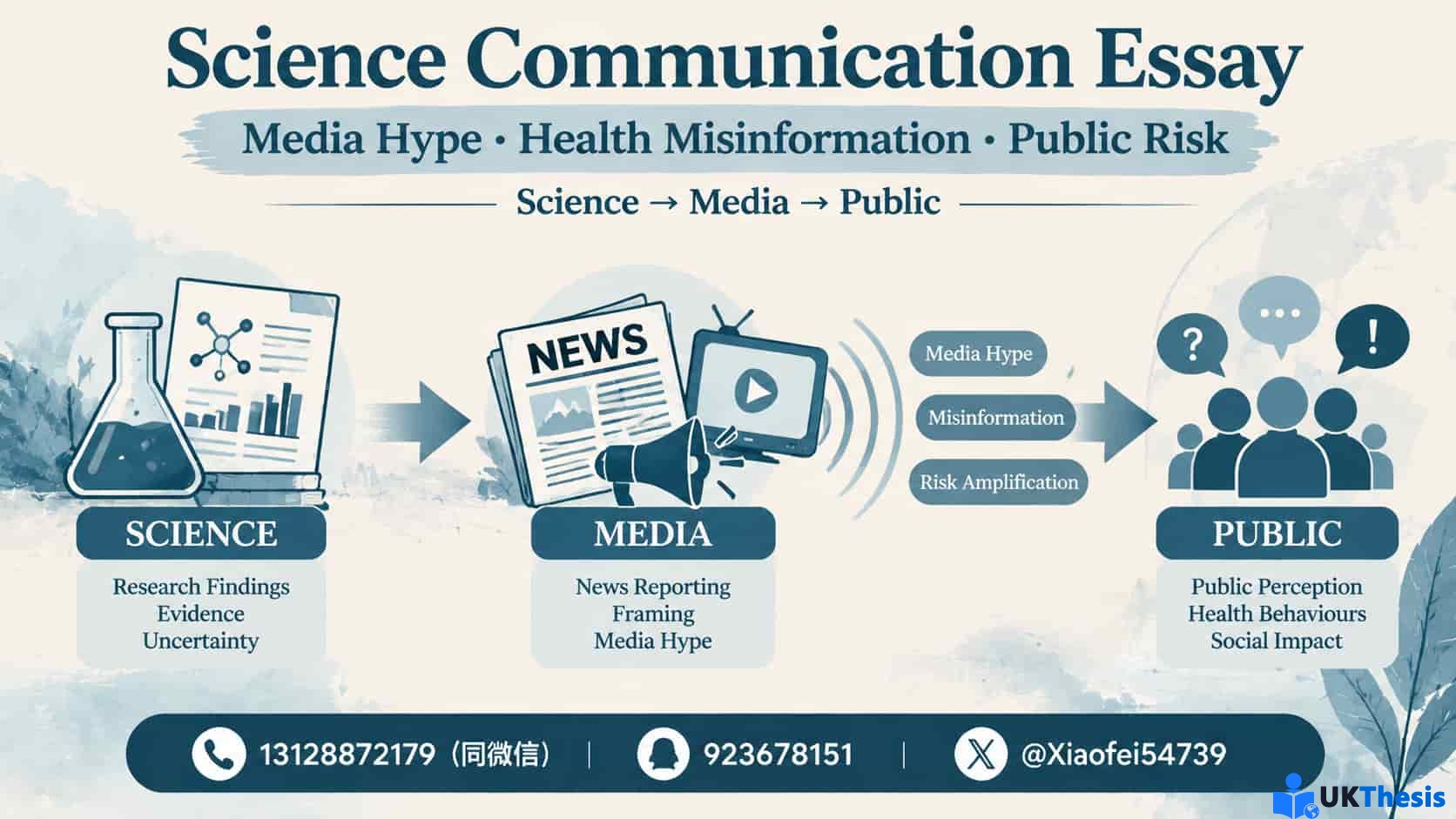
真正值得讨论的问题其实更具体:科学知识从scientists走向public的过程中发生了什么?媒体为了吸引注意力,会不会改变风险的呈现方式?当health information遇到breaking news、灾难报道甚至misinformation时,公众到底是在理解科学,还是在理解媒体包装后的科学?
下面这篇Science Communication Essay以public communication of science为核心,讨论science communication models、media hype、risk amplification以及health misinformation。它本质上属于Media Studies与Communication方向的research-based essay,也可以作为Science Communication assignment的结构参考。
The Public Communication of Science
Science communication involves the exchange of scientific information between scientists, journalists, institutions and members of the public. It can include communication between specialists, educational communication and the presentation of scientific issues through newspapers, television and other forms of media.
The difficulty is that information does not always move unchanged from the scientific community to the public.
Scientists may concentrate on research data, uncertainty and methodological detail. Journalists usually work with different pressures: limited space, deadlines, audience attention and the need to explain technical subjects to people without specialist knowledge.
The relationship between science and media is therefore not simply a matter of transferring information from one place to another.
| Participant | Main Concern | Possible Communication Problem |
|---|---|---|
| Scientists | Accuracy, evidence, uncertainty | Technical language may be difficult for general audiences |
| Journalists | News value, clarity, audience attention | Complex findings may be simplified |
| Public | Understanding personal or social relevance | Risk may be interpreted without scientific context |
| Institutions | Public information and trust | Messages may compete with media narratives |
From Specialist Science to Public Communication
One way of understanding science communication is to imagine scientific information moving through different communication environments.
At the intraspecialist level, researchers communicate primarily with specialists working within the same field. Experimental papers, technical terminology, detailed methods and specialist journals belong largely to this level.
The interspecialist level allows communication between researchers who may belong to related fields but do not necessarily share exactly the same specialist knowledge.
The pedagogic level includes textbooks and teaching materials. Here, scientific knowledge is reorganised so that students can understand established theories, concepts and methods.
Finally, the popular level includes newspapers, television documentaries, magazines and other forms of public-facing science communication.
| Communication Level | Typical Audience | Typical Content |
|---|---|---|
| Intraspecialist | Researchers in the same specialist field | Research papers, experiments, technical data |
| Interspecialist | Researchers across related areas | Cross-disciplinary papers and conferences |
| Pedagogic | Students | Textbooks and teaching materials |
| Popular | General public | News, documentaries and popular science |
The movement between these levels is not simply a matter of shortening a scientific paper. Information is selected, translated and placed into a new context.
写Science Communication Essay时这一点特别好用:不要只写“媒体传播科学”。继续追问一步:从research paper变成新闻标题以后,什么被保留下来了,什么被简化了,又有什么被放大了? 这一步就开始从Description进入Analysis。
Media Hype and the Communication of Risk
Media attention can be particularly influential after disasters or during public health events.
A dramatic event creates an immediate demand for information. Journalists search for explanations, experts, personal stories and possible consequences. As coverage increases, related incidents and health concerns may receive additional attention.
This process can develop into what is often described as media hype: an issue receives intensive and repeated coverage, which can encourage further stories about the same subject.
This does not mean that every heavily reported risk is false. The more useful question is whether the amount and framing of coverage remain proportionate to the available evidence.
The Bijlmermeer Crash and Health Concerns
The aftermath of the Bijlmermeer plane crash provides an interesting example of the relationship between disaster reporting, health concerns and public perception.
After a highly publicised event, people naturally look for explanations when experiencing symptoms or anxiety. Media reports can become part of the framework through which those experiences are interpreted.
The case therefore raises an important communication question: does increased reporting merely reflect existing public concern, or can repeated reporting itself contribute to the way risk is perceived?
The answer is not necessarily simple. Media attention, individual experience, official communication and uncertainty can interact with one another.
| Stage | Possible Effect |
|---|---|
| Major event occurs | Strong demand for information |
| Intensive media coverage | Public attention concentrates on particular risks |
| Related cases receive coverage | Issue appears increasingly widespread |
| Repeated exposure | Risk perception may become amplified |
Disaster Coverage and Public Anxiety
Similar questions appear in discussions of television coverage following major disasters and terrorist attacks.
Events such as the September 11 attacks and the Oklahoma City bombing generated extensive and repeated media coverage. Graphic images, continuous news cycles and repeated replaying of traumatic scenes brought the events into homes far beyond the immediate disaster areas.
This created a new question for researchers interested in communication and public health: can repeated exposure to distressing media coverage influence psychological responses among people who were not physically present at the event?
The important point for a Media Studies Essay is not to claim that television automatically causes trauma. Instead, the case demonstrates that media exposure itself can become one variable when researchers study responses to disasters.
这里很容易写过头:“9/11 television coverage caused PTSD”这种句子太绝对。Academic Writing最好改成research has examined associations between repeated media exposure and post-traumatic stress symptoms。一个词从“cause”换成“association”,严谨程度完全不一样。
Science Journalism: Accuracy or Attention?
Science journalists face a difficult balance.
Scientific research usually contains uncertainty, limitations and qualifications. News stories, however, need to communicate quickly and clearly.
A journalist reporting a new medical study therefore has to decide which details are essential, which technical explanations can be simplified and how strongly the findings should be presented.
Problems emerge when simplification changes the meaning of the evidence.
A preliminary association may become a headline suggesting causation. A study conducted on a limited population may be presented as if its findings apply universally. A possible health risk may appear more certain than the research actually indicates.
Health Misinformation and the Media
Misinformation creates an additional problem because inaccurate information can continue influencing attitudes even after corrections appear.
Online media have made this issue more complicated. Information no longer travels only from scientists to professional journalists and then to readers. Social platforms, search engines, websites and individual users can all participate in the circulation of health information.
A story that resembles professional journalism may therefore reach a large audience even when the evidence behind it is weak.
This makes media literacy increasingly important. Readers need to ask where a claim originated, whether it is supported by evidence and whether the headline accurately represents the research being discussed.
| Question | Why Ask It? |
|---|---|
| Who produced the information? | Helps identify the original source |
| What evidence supports it? | Separates evidence from assertion |
| Does the headline match the research? | Identifies possible exaggeration |
| Is correlation presented as causation? | Tests whether conclusions exceed the evidence |
The Swine Flu and Moral Panic
Public health emergencies demonstrate particularly clearly why the framing of risk matters.
During the swine flu outbreak, dramatic predictions and headlines contributed to intense public attention. This provides a useful example for discussing the idea of risk amplification.
A health threat may be real while individual reports about that threat still exaggerate particular possibilities.
Those two statements are not contradictory.
This distinction is important in science communication because responsible reporting needs to communicate uncertainty without either minimising genuine risks or turning uncertain outcomes into inevitable disasters.
Why the Traditional Communication Model Can Be Problematic
A traditional view of science communication imagines knowledge moving in one direction: scientists possess information, the media transmit it and the public receives it.
Real communication is more complicated.
Members of the public interpret scientific information through personal experience, previous beliefs, social relationships and other media messages. Journalists decide what becomes news. Scientists themselves may disagree about interpretation or uncertainty.
Science communication is therefore better understood as interaction rather than simple delivery.
| Simple Model | More Realistic View |
|---|---|
| Scientist → Media → Public | Multiple actors interpret and reshape information |
| Public receives knowledge | Public also interprets, questions and circulates information |
| Scientific facts are simply transferred | Framing and context affect meaning |
| Communication failure means lack of information | Trust, uncertainty and interpretation can also matter |
Conclusion
The public communication of science cannot be understood simply as the transfer of scientific facts from experts to a passive audience.
Scientific information moves through different communication environments, from specialist research and education to journalism and public discussion. During that movement, information may be simplified, reframed or amplified.
Media coverage is especially influential during disasters and public health emergencies because uncertainty and public demand for information are both high.
The Bijlmermeer crash, major disaster coverage and public health reporting demonstrate why researchers need to consider not only whether information is accurate, but also how frequently it is repeated, how risk is framed and how audiences interpret it.
Science journalism therefore involves a difficult responsibility. Reporters need to make specialised information understandable without turning uncertainty into certainty or complexity into sensationalism.
For readers, the lesson is equally important: access to more information does not automatically produce better understanding. The quality, source and framing of that information still matter.
这篇Science Communication Essay可以学什么?
| 比较普通的写法 | 可以继续分析 |
|---|---|
| Media influences people | 媒体通过什么framing mechanism影响risk perception? |
| Misinformation is harmful | 为什么correction出现以后错误信息仍可能留下影响? |
| Science is difficult | 科学知识从specialist level进入popular level时发生了什么变化? |
| Media exaggerates risks | 怎样区分legitimate warning与risk amplification? |
我以前看这种Media Essay最怕一种写法:前面一句“media is powerful”,后面举三个新闻例子,然后Conclusion再说一次“therefore media is powerful”。材料很多,分析却原地踏步。
更好的办法是抓住一个机制,例如risk amplification。然后问:什么事件触发报道?媒体怎样重复?公众怎样理解?新的报道为什么又出现?这样案例才真正服务于Argument。
FAQ
Science Communication Essay属于Media Studies吗?
很多情况下属于。Science Communication本身具有跨学科特点,可以出现在Communication、Media Studies、Science and Society、Public Health等课程中,最终应以具体Assignment Brief为准。
Media Hype是什么意思?
在这类Essay中,Media Hype通常用于讨论某一事件受到高度集中和重复报道,并可能进一步推动相关报道和公众关注的传播过程。写作时最好结合具体案例,而不是简单把所有大量报道都称为hype。
Health Misinformation Essay可以写哪些角度?
可以讨论source credibility、social media、science journalism、risk communication、correction、public trust以及correlation与causation在新闻报道中的误用。
Science Communication Essay需要case study吗?
不一定,但具体案例通常能让抽象理论更容易分析。例如公共健康事件、灾难报道或某一次科学争议都可以成为Evidence。
Media Studies Assignment资料太多怎么整理?
先确定一个核心communication mechanism,再选择真正能说明这个机制的案例。如果理论、案例和Essay Structure混在一起,可以通过Media Studies Essay写作辅导先整理research Question、Thesis与Evidence关系,再进入正文。
相关文章阅读
如果还在区分不同Essay类型,可以继续阅读站内Essay Samples、Academic Writing以及Expository Essay相关内容。Science Communication这一页更适合作为具体学科Sample,而不是承担“How to write an essay”的总教程功能。
这类题真正有意思的地方不是证明“媒体会影响公众”——这个结论太容易了。难的是解释影响究竟发生在哪里。从scientific evidence到headline,再从headline到public perception,中间每走一步,都是可以写进Essay的分析空间。