
Game Theory放在商科assignment里,经常给人一种“看起来很数学,应该很难”的感觉。其实真正理解之后,它研究的事情挺接地气:当你的决定会影响竞争对手,而竞争对手的决定又反过来影响你时,你到底应该怎么选?
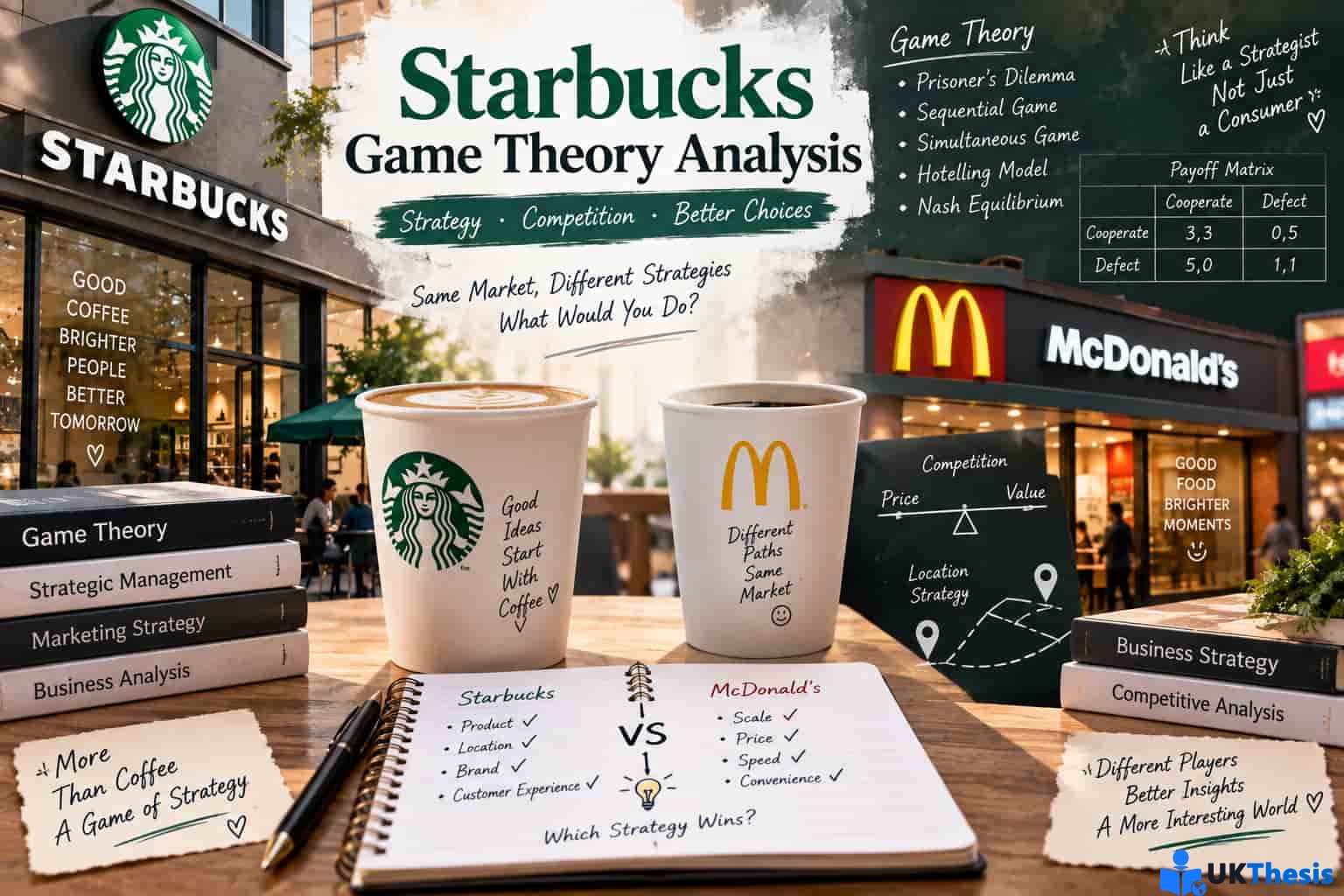
这篇Starbucks Game Theory案例分析的原题为An Analysis of Starbucks Using Game Theory,主要利用博弈论中的Dominant Strategy、Prisoner’s Dilemma、Sequential Game以及Hotelling Model等概念,分析Starbucks扩张、门店选址及其面对McDonald’s进入咖啡市场时可能采取的竞争策略。
阅读提示:本文中的部分公司数据和竞争情境来自历史时期,因此更适合作为Game Theory、Strategic Management和Business case study的经典分析材料,而不是2026年Starbucks实时经营数据。学习重点在于如何把现实商业竞争转换成Game Theory模型。
Introduction: Starbucks as a Strategic Competition Case
Starbucks Corporation developed from a local coffee business into one of the most recognised international coffeehouse brands. Its growth was supported by a combination of store expansion, brand positioning, location strategy and the development of a consistent customer experience.
As the company expanded, however, it increasingly faced strategic competition. Competitors did not simply copy Starbucks; they made their own decisions about pricing, locations, product offerings and market entry. Starbucks therefore had to make decisions while anticipating how competitors might respond.
This is exactly where Game Theory becomes useful.
Game Theory helps explain situations in which the outcome of one company’s strategy depends partly on the decisions made by other players in the market. In this case, Starbucks and competitors such as McDonald’s can be treated as strategic players whose actions influence one another.
What Is Game Theory?
In simple terms, Game Theory studies strategic interaction between rational decision-makers. A game normally contains three basic elements:
| Element | Meaning | Business Example |
|---|---|---|
| Players | Decision-makers in the game | Starbucks and McDonald’s |
| Strategies | Actions available to each player | Enter, lower prices, accommodate, expand locations |
| Payoffs | Results produced by different strategy combinations | Revenue, market share or profit |
The important point is that the best decision cannot always be made by looking only at one company. A company has to ask:
If we choose Strategy A, what is our competitor likely to do next?
这也是Game Theory essay和普通Business Essay最明显的区别。普通分析可能只问“Starbucks应该怎么做”;博弈论会继续追问:“如果Starbucks这么做,McDonald’s会怎么反应?然后Starbucks又怎么办?”一下子就有互动了。
Dominant and Dominated Strategies
A strategy can be described as strictly dominant if it produces a higher payoff for a player than its alternative strategies regardless of what the other player chooses.
A dominated strategy is the opposite. If another available strategy consistently produces a better result, the weaker strategy can often be eliminated from consideration.
This process is useful because a complicated business problem may initially contain many possible strategies. Eliminating clearly inferior options can make the remaining decision easier to analyse.
In practical business analysis, however, identifying a dominant strategy is not always straightforward. Real markets contain uncertainty, incomplete information and changing customer behaviour. Therefore, Game Theory should normally be treated as a structured way of thinking rather than a guarantee of future business performance.
Prisoner’s Dilemma
The Prisoner’s Dilemma is one of the best-known concepts in Game Theory. It demonstrates how two rational players may choose strategies that leave both of them worse off, even though cooperation could produce a better combined result.
This type of situation can occur in business competition.
Imagine two coffee chains competing in the same market. Both could maintain stable prices. However, each company worries that the other might cut prices first and attract more customers. If both companies respond by aggressively reducing prices, a price war can emerge.
| Situation | Possible Effect |
|---|---|
| Both maintain prices | Both may protect margins |
| One cuts price | The discounting firm may attract price-sensitive customers |
| Both cut prices | Customers benefit, while both firms may experience lower margins |
所以看到竞争对手降价,马上跟着砍价,并不一定是最聪明的商业反应。大家一起把利润砍没了,最后开心的可能只有消费者。
Sequential Game
A Sequential Game occurs when players make decisions in sequence. A later player can observe or respond to an earlier player’s action.
This matters in Strategic Management because many business decisions occur in exactly this way.
For example, one company may:
Enter a market → competitor observes entry → competitor responds.
The order of decisions therefore matters.
Sequential Games can often be analysed using backward induction. Instead of beginning with the first decision, the analyst considers what the final player is likely to do and then works backwards.
Competitor enters → Starbucks responds → Expected payoff → Work backwards to the entry decision
Simultaneous Game
In a Simultaneous Game, players choose their strategies without knowing the choice being made by the other player at the same time.
Unlike a Sequential Game, there is no opportunity to observe the competitor’s move before making the decision.
Pricing decisions can sometimes resemble this situation. If two competitors independently decide next month’s promotional prices before observing the other firm’s final decision, each company has to make assumptions about what its rival is likely to do.
Ultimatum and Dictator Games
The Ultimatum Game involves two players dividing a resource. One player proposes a division and the second player can either accept or reject it. If the offer is rejected, neither party receives the proposed payoff.
The Dictator Game is similar, but the second player has little or no influence over the allocation. The first player effectively decides how the available resources are distributed.
Although these models are less directly related to Starbucks than location competition or market entry, they demonstrate an important principle: strategic outcomes are affected not only by the amount of resources available, but also by bargaining power and the choices available to each player.
Hotelling Game and the Linear City Model
The Hotelling Model is particularly useful for analysing Starbucks because it considers how competitors choose locations or positions relative to each other.
The simplified idea is quite intuitive.
Imagine customers distributed along a street. Two coffee shops must decide where to locate. If one business moves closer to the centre of customer demand, its rival may also have an incentive to move closer to the same area.
The result can be clustering.
| Hotelling Concept | Starbucks Interpretation |
|---|---|
| Location | Where a coffee shop is positioned relative to customers and competitors |
| Transportation Cost | Customer inconvenience associated with travelling farther |
| Differentiation | Brand experience can compensate for price or distance differences |
| Clustering | Competing stores may locate relatively close to centres of demand |
Application of Hotelling Model to Starbucks
The historical Starbucks case can be analysed using the Linear City Model. Suppose a local coffee shop occupies a convenient position within a particular customer market. When Starbucks enters the same area, the distance between Starbucks, the existing competitor and the customer becomes part of the purchasing decision.
Convenience, however, is not necessarily the only factor.
Starbucks also developed a recognisable customer experience and Brand identity. Therefore, a consumer may be willing to travel slightly farther or pay a higher price if the perceived value of the Starbucks experience compensates for the additional cost.
The original case illustrated this idea using a simplified utility calculation:
Customer Utility at Starbucks:
WTP − Price
Customer Utility at Competitor:
WTP − (Price + Transportation Cost)
WTP means Willingness to Pay. The customer compares the perceived value of each option with its total cost.
This simple model explains why competing only on coffee price may fail to capture the whole purchasing decision. Brand perception, convenience and location can all influence consumer choice.
Why Do Starbucks Stores Sometimes Cluster?
The Hotelling framework also helps explain the idea of competing businesses locating close to one another.
At first this can look strange. If there is already a coffee shop on a busy street, why would another coffee shop open nearby instead of going somewhere with no competitor?
Because the existing location may already reveal something extremely valuable:
customers are there.
A company locating close to an established centre of demand may capture part of the existing customer traffic. Competitors then respond to one another, which can create clusters of similar businesses.
This idea should not be interpreted as proof that every Starbucks location was literally chosen through a Hotelling equation. In a Business Case Study, the model is better used as an analytical framework for understanding location competition.
Starbucks vs McDonald’s: A Sequential Game
The competition between Starbucks and McDonald’s provides another useful Game Theory example.
Historically, Starbucks occupied a strong position in the specialised coffeehouse market. McDonald’s expansion into coffee products created a potential competitive challenge because the two companies could appeal to overlapping customer groups.
The strategic problem can be simplified into two stages:
Stage 1: McDonald’s chooses Entry or No Entry
↓
Stage 2: Starbucks chooses Accommodate or Fight
“Fight” might involve an aggressive price response, while “Accommodate” means continuing to compete without attempting to trigger a major price war.
Look Forward, Reason Back
Sequential Games are often solved by looking at the later decision first.
Suppose McDonald’s enters the specialised coffee market. Starbucks then has two simplified options:
| Starbucks Strategy | Possible Consequence |
|---|---|
| Fight | Reduce prices aggressively and sacrifice margin in an attempt to protect market share |
| Accommodate | Allow market entry while continuing to compete through Brand, experience and customer loyalty |
The historical calculation in the original case suggested that an aggressive price reduction could impose a larger revenue cost on Starbucks than accommodating McDonald’s entry.
The exact historical figures should not be treated as current forecasts. What matters is the strategic logic:
If fighting the entrant costs more than sharing part of the market, accommodation may be the rational response.
我觉得这里是整篇范文最值得学生学习的部分。不是看到“竞争对手来了”就写一句“Starbucks should reduce prices”。真正的Critical Analysis应该继续算:降价以后自己损失多少?不降价又会损失多少?哪个Payoff更合理?
A Simplified Payoff Logic
| McDonald’s Decision | Starbucks Response | Strategic Logic |
|---|---|---|
| No Entry | Maintain existing strategy | No reason to create a price war unnecessarily |
| Entry | Aggressive price fight | May protect some customers but reduce margins substantially |
| Entry | Accommodation | Accept some competition while preserving premium positioning and margins |
Nash Equilibrium and Best Response
A Nash Equilibrium occurs when each player is choosing a strategy that represents a best response to the strategy chosen by the other player. Neither player has an incentive to change strategy unilaterally.
In the Starbucks example, equilibrium thinking can be applied to both location decisions and competitive responses.
If Starbucks and a competitor have already selected locations or strategies such that moving independently would make either company worse off, the market may have reached a relatively stable strategic position.
This does not mean competition disappears. It means that, given the rival’s current decision, changing strategy alone may not improve the player’s payoff.
What Can We Learn from This Starbucks Case Study?
如果把这篇文章当成Game Theory essay范文,最值得学习的不是那些数字,而是它的分析路线:
Business Problem → Players → Strategies → Payoffs → Competitor Response → Best Response → Strategic Decision
这个结构特别适合Strategic Management和Business Strategy Assignment。
比如老师问:
How should a company respond to a new competitor entering its market?
普通答案可能会直接列:
降低价格、做广告、改善服务、增强品牌。
看起来什么都有,但没有真正回答“为什么”。
Game Theory的写法会先定义Players,然后列出可选Strategies,再分析不同Strategy Combination对应的Payoff,最后解释哪个选择更合理。
所以Game Theory其实不是为了把Assignment写得像数学考试,而是帮助学生把“竞争对手会怎么反应”这一层真正放进Strategic Analysis里面。
如果在Business Strategy、Strategic Management或Game Theory Assignment中卡在题目理解、模型选择、Payoff Matrix、Case Study结构或Critical Analysis等环节,也可以先通过论文写作辅导把Assignment Brief和分析框架梳理清楚,再决定哪些模型真正需要使用。理论不是越多越好,能够真正解释案例才有价值。
Conclusion
The Starbucks case illustrates how Game Theory can be used to understand strategic competition in real business environments.
The Hotelling Model provides a useful framework for analysing location decisions and the clustering of competing businesses. Sequential Game Theory, meanwhile, helps explain how Starbucks might respond to the entry of a competitor such as McDonald’s.
The key strategic lesson is that aggressive competition is not automatically the best response. A price war may protect some market share while simultaneously damaging profitability. When the cost of fighting is greater than the cost of accommodating a competitor, maintaining Brand differentiation and accepting some competitive overlap may represent a more rational strategy.
Game Theory therefore encourages managers to move beyond the question “What should we do?” and ask a more useful question: “What will our competitor probably do after we make that decision?”
FAQ:Starbucks Game Theory常见问题
1. Starbucks Game Theory属于Marketing Essay吗?
可以涉及Marketing和Pricing,但更准确的定位是Business Strategy、Strategic Management和Game Theory Case Study。
2. 这篇文章属于Economics Essay吗?
Game Theory本身是经济学的重要分析工具,因此可以用于Economics Assignment;但本文应用重点是企业竞争战略,所以Business Strategy定位更准确。
3. Hotelling Model是什么意思?
Hotelling Model可以用来分析企业在位置或产品空间上的竞争选择。放到咖啡店案例中,可以帮助理解消费者位置、便利性以及竞争者选址之间的关系。
4. Starbucks为什么可以用Game Theory分析?
因为Starbucks的价格、选址和竞争策略都会受到其他公司的决策影响。只要一个企业的最佳选择取决于竞争对手如何行动,就适合使用Game Theory思路。
5. Starbucks vs McDonald’s属于Sequential Game吗?
在本文构建的模型中可以这样处理:McDonald’s先决定是否进入,Starbucks再决定Accommodate还是Fight,因此可以使用Sequential Game和Backward Induction分析。
6. 需要同时加入SWOT和PESTEL吗?
没有必要。除非Assignment Brief明确要求,否则这篇文章围绕Game Theory、Hotelling Model和Competitive Strategy展开已经足够。加入太多框架反而容易分散主题。
7. Game Theory Essay怎样写出Critical Analysis?
不要只解释理论定义。需要明确Players、Strategies和Payoffs,并比较不同选择可能产生的结果以及竞争对手可能采取的Best Response。