
Travel and Tourism Entrepreneurship 是市场营销、Business Management以及Entrepreneurship课程里很典型的一类essay题目。看上去是在聊“旅游”,实际上真正考察的通常是一个创业者怎样观察市场、确定目标客户、设计旅游产品、安排Marketing Strategy,并在Business Start-up阶段判断资金、风险与企业目标。
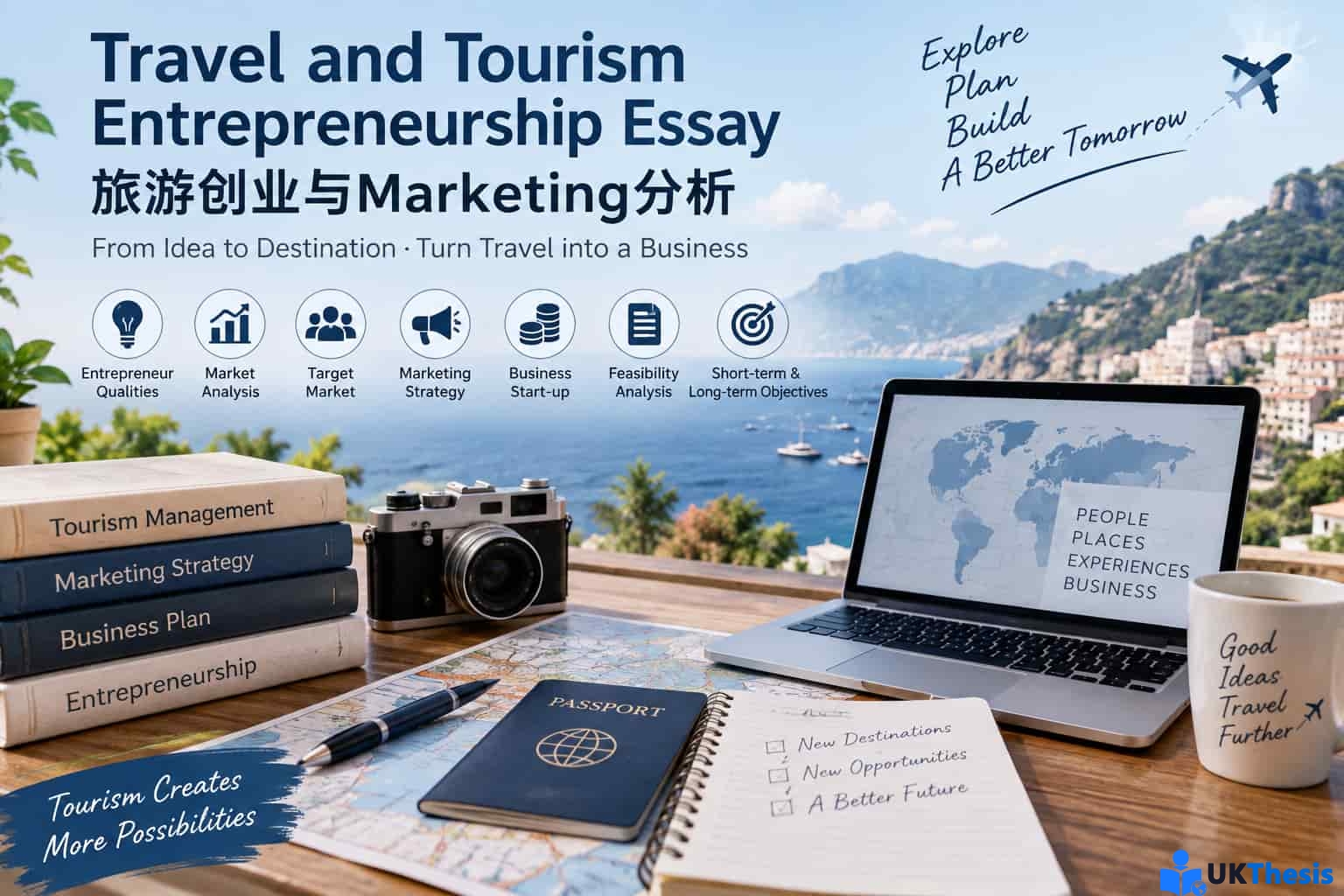
我以前看这类Business assignment时,经常碰到一个小问题:同学特别容易把它写成旅游行业介绍。景点说了一堆、行业前景说了一堆,结果写到最后才发现,老师真正想看的Entrepreneurship反而只有两段。这篇Travel and Tourism Entrepreneurship essay范文比较有参考价值的一点,就是它从创业者能力一路写到Market Saturation、Marketing、Feasibility和Financial Planning,比较完整地呈现了旅游创业企业的基本分析思路。
这篇范文主要涉及:
Travel and Tourism Entrepreneurship、Marketing Strategy、Entrepreneur Qualities、Target Market、Business Start-up、Feasibility Analysis、Financial Planning以及Short-term / Long-term Objectives。
Introduction
Travelling and tourism can be considered one of the important businesses in the contemporary world. The continuing demand for tourism and travel has created opportunities for entrepreneurs because people from different countries travel for leisure, business and other purposes. Tourism is also an important source of revenue for destinations such as Malaysia, Thailand, the United States and Australia.
Like every business, however, a tourism enterprise should be evaluated according to its feasibility, expected return and potential risks. An individual who wants to establish a tourism business needs more than enthusiasm. Knowledge of the market, customer demand, available resources, competition and operating costs all affect whether the business can survive.
The history of travel and tourism is very old. Ancient travellers crossed regions and countries even when transport and communication resources were limited. In the contemporary tourism industry, improved transportation, digital technology, online booking systems and tourism facilities have made planning considerably easier. At the same time, technology has also increased competition because customers can compare destinations, prices and reviews before making a decision.
Qualities in the Travel and Tourism Entrepreneur
Travel and tourism entrepreneurship is influenced by several important factors. A successful entrepreneur should possess relevant knowledge, leadership and management skills, awareness of new technology, familiarity with tourism products and a practical understanding of the market.
Travelling and tourism is not only about investment and revenue. Interest and creativity are also important. Interest allows an entrepreneur to understand changes within the industry, while creativity can help in designing travel schedules, packages and customer experiences that are different from those already available in the market.
A good entrepreneur should pay attention to customer needs and adjust offers accordingly. Marketing ability is equally important. A business may have an attractive tourism product, but without suitable communication and promotion, potential customers may never become aware of it.
In the longer term, customer satisfaction can contribute to repeat business and recommendations. A tourism entrepreneur therefore needs a combination of business knowledge, market awareness, creativity, customer service and management skills. The entrepreneur should also understand what competitors are offering and consider how the company can develop a meaningful point of difference.
| Entrepreneur Quality | Why It Matters | Tourism Example |
|---|---|---|
| Market Knowledge | Helps identify demand and competition | Understanding which destinations or packages customers prefer |
| Creativity | Supports differentiation | Designing distinctive tours or themed packages |
| Marketing Skills | Connects services with target customers | Choosing suitable digital and offline promotion |
| Customer Awareness | Improves satisfaction and retention | Adjusting packages to customer expectations |
Development of Entrepreneurial Enterprises and Significant Influential Factors
In order to develop an entrepreneurial enterprise, several initial considerations are important. These include global tourism trends, local market saturation, the targeted business domain, appropriate modes of marketing, social contacts, changes in the travel and tourism industry, creativity in organising business offers and the design of promotional packages.
For a Business or Marketing Essay, these factors should not simply be listed. A stronger analysis explains how they influence one another. For example, a highly saturated local market may force a new travel agency to narrow its target segment; that decision then changes the type of package offered and the most suitable marketing channel.
Global Trend of Tourism Business
The first step in developing a tourism enterprise is to observe wider tourism trends. An entrepreneur should understand which destinations are attracting travellers, what types of packages are popular and how demand changes across different periods.
Christmas and New Year provide a simple example. A travel company may study where customers prefer to travel during these periods and then consider whether it can design suitable packages. Domestic tourism should also be considered because customers do not always travel internationally.
A tourism entrepreneur therefore needs to remain informed about changing consumer behaviour, transport conditions, technology and destination popularity. Rather than assuming that tourism demand is always stable, the company should be prepared for changes in economic conditions, travel restrictions and customer pReferences.
Local Market Saturation Levels
Local market saturation is another important consideration. If several established travel companies are already operating in the same area, a new business may find it difficult to compete directly, especially when financial resources are limited.
Instead of immediately challenging the largest businesses, a new company can investigate smaller competitors and identify gaps in the local market. What services are customers unable to obtain? Which customer groups are poorly served? Are competitors weak in service quality, flexibility, niche destinations or digital communication?
After analysing these questions, the entrepreneur can develop a work plan around an identifiable market opportunity. In a competitive market, quality standards, reliable arrangements, customer communication and the ability to meet promised deadlines can also influence reputation.
| Market Situation | Possible Response |
|---|---|
| Many established competitors | Avoid competing on every segment at once |
| Limited start-up capital | Focus resources on a manageable niche |
| Competitors offer similar packages | Develop service or experience differentiation |
| Low customer loyalty | Improve service, trust and post-purchase communication |
Targeted Business Domain
The company should focus on a clearly defined target domain. The selected market should be realistic enough for the company to serve effectively. If a new business cannot compete across the entire European travel market, for example, it may be more practical to specialise in a destination, customer group or particular type of travel experience.
Strong management and attractive packages can help the company build customer trust. A clearly targeted business domain also makes marketing more efficient because the company knows who it wants to reach and what type of message is likely to appeal to them.
Modes of Marketing
The selection of appropriate marketing channels is an important business decision. Different tourism services may require different forms of promotion, and the decision should depend on available resources and the characteristics of the target market.
Traditional print advertising can still be useful in some situations, while websites, search engines, social media, email and online travel platforms now play an increasingly important role in tourism marketing. The point is not to use every available channel. A sensible Marketing Strategy matches the communication method to the customer group.
Social Contacts
Social contacts can also contribute to business development. Relationships with customers, suppliers and other members of the business community may provide information, referrals and promotional opportunities. In tourism, cooperation can be particularly important because travel products often involve several different providers, including accommodation, transport, attractions and local services.
Awareness of Global Changes in Travel and Tourism
Travel businesses are affected by events that may be outside the direct control of an individual company. Regional conflicts, security incidents, natural disasters, economic changes or public health events can quickly alter travel demand.
A tourism enterprise therefore needs flexibility. If a destination temporarily becomes unattractive or difficult to access, the company may need to adjust its target destinations or promote alternative products. The broader lesson for an Entrepreneurship Assignment is that risk management is not simply about calculating start-up costs; it also involves the ability to respond when the external environment changes.
Appealing Promotional Packages
Promotional packages can help attract customers when they are designed around genuine customer needs. Attractive pricing alone is not enough. Accommodation quality, transportation, itinerary design, service reliability and the overall customer experience should support the promise made in the promotion.
A successful tourism entrepreneur therefore needs to balance promotion with delivery. A package that looks exciting in an advertisement but disappoints customers in practice may create short-term sales while damaging long-term reputation.
Business Start-Up Plan
Starting a business involves several important stages. Before establishing a tourism enterprise, the entrepreneur should consider whether the project is feasible. Market reconnaissance and feasibility analysis can provide an initial picture of the opportunity, the likely customer base and the competitive environment.
Market Reconnaissance and Feasibility Analysis
These steps take place before the business is fully established and can become important parts of an effective Business Plan. The analysis may include the location and identity of the travel agency, access to customers, services already offered by competitors, weaknesses within the existing market and areas where a new company may be able to differentiate itself.
This is where many Business Assignment drafts become a little too optimistic. Writing “tourism is growing, therefore the business will succeed” is not really feasibility analysis. A useful feasibility discussion needs to ask whether enough customers exist, whether the business can reach them and whether expected revenue can reasonably cover operating costs.
Financial Analysis and Capital Calculation
Every business requires some level of initial capital. The entrepreneur should estimate the intended size of the business and identify the resources required to operate it. A larger operation normally needs greater financial support, while a smaller start-up may be able to begin with a more limited cost structure.
Early calculations should consider items such as premises, staffing, technology, marketing, booking systems, insurance and the cost of arranging tourism services. Financial planning should not simply assume that investors will automatically obtain a return. A more realistic approach is to explain expected costs, revenue assumptions and major uncertainties so that potential investors can assess the proposal properly.
| Start-up Area | Questions to Consider |
|---|---|
| Market | Is there sufficient demand? |
| Competition | How crowded is the market and where are the gaps? |
| Finance | How much capital is required and what are the major costs? |
| Customer | Who is the target customer and what problem is being solved? |
| Marketing | Which channels can reach the target market efficiently? |
Agenda of the Company
The agenda of the company brings together its aims, objectives and expected direction. These objectives should be understandable to managers, employees and potential investors. For a tourism agency, a clear strategic direction can also support marketing because customers are more likely to understand what the company specialises in.
At the same time, objectives should not be treated as something that can never change. Market conditions change, so the company may need to adjust specific targets while maintaining its broader purpose.
Objectives of the Business
Business objectives can be divided into short-term and long-term objectives. Both are important because short-term objectives guide immediate action, while long-term objectives describe where the organisation wants to develop over time.
Short-Term Objectives
Short-term objectives are generally more specific and measurable than long-term objectives. They may cover the first six months or first year of operation and could include customer acquisition, revenue targets, reduction of initial liabilities, establishment of marketing channels and improvement in operational efficiency.
Long-Term Objectives
Long-term objectives normally relate to business development and expansion. They may cover a period of five or ten years and could involve introducing new services, entering additional regions, building a stronger brand or expanding from a local operation to a national or international business.
Appropriate Targeted Marketing Techniques
Marketing techniques should be selected according to the target customers of the business. These techniques can include both physical and digital communication.
Digital approaches may include website content, search marketing, social media and online advertising. Traditional approaches can include printed promotional materials and partnerships with local organisations. The effectiveness of each technique depends on the market being targeted.
Service quality is equally important. A travel company that advertises widely but delivers poor experiences will find it difficult to build sustainable customer relationships. For this reason, Marketing in tourism should not be separated from service delivery and quality assurance.
从这篇Marketing Essay范文能学到什么?
如果把这篇文章当作留学生Business Assignment范文来看,我觉得最值得参考的并不是某一句英文,而是它的分析顺序:
Entrepreneur → Market → Target Customer → Marketing → Feasibility → Finance → Objectives
这个顺序挺适合Entrepreneurship类题目。很多同学最容易犯的错误,是Business Plan写到哪算哪:前面说客户,突然跳到资金,接着又回来说Marketing。看的人没疯,自己先写晕了。
如果学校Assignment Brief要求更强的Critical Analysis,可以进一步加入真实旅游企业数据、行业报告或者具体市场案例,用Evidence判断哪些策略真正可行,而不是只解释概念。
如果在Marketing Essay、Business Assignment或Entrepreneurship Coursework写作过程中卡在题目理解、结构安排、案例分析或英文表达,也可以先从Assignment Brief和评分要求入手进行论文写作辅导和结构梳理。比起一上来堆很多“高级理论”,先把题目究竟要求分析什么弄清楚,通常更重要。
Conclusion
Travelling and tourism continues to provide opportunities for entrepreneurial activity, but the feasibility of an individual business depends on more than general industry growth. Knowledge, planning, market positioning, customer understanding, financial preparation and appropriate marketing all influence the development of a tourism enterprise.
An entrepreneur should pay attention to changing tourism trends, local competition and customer expectations while designing products that the business can realistically deliver. Market research and feasibility analysis can help identify whether the proposed business model is workable, while clear short-term and long-term objectives provide direction after the business begins operating.
Ultimately, attractive packages and effective marketing may help a tourism business gain customer attention, but sustainable development depends on whether the company can combine promotion with reliable service, sound financial planning and an ability to adapt to changing market conditions.
FAQ:Travel and Tourism Entrepreneurship Essay常见问题
1. Travel and Tourism Entrepreneurship属于Essay还是Assignment?
两种叫法都可以。Assignment是课程作业的统称,而这篇文章的实际写作形式更接近Business Essay或Marketing Essay,因此后台可以同时使用Essay和Assignment相关Tag。
2. 这篇文章属于Marketing吗?
属于。虽然主题是旅游创业,但正文大量涉及Target Market、Marketing Techniques、Promotional Packages、Customer Needs和Competition,因此Marketing是重要组成部分。
3. 可以把它归为Business Plan吗?
可以作为相关知识点,但整篇文章并不完全是一份正式Business Plan。Business Start-up和Feasibility Analysis只是其中的重要章节。
4. 需要加入PESTEL吗?
不一定。本文主要分析创业、市场、营销和企业规划。只有当Assignment Brief明确要求Macro Environment Analysis时,才有必要进一步加入PESTEL。
5. Tourism Essay怎样提高Critical Analysis?
不要只写旅游行业“发展很好”。可以讨论市场饱和、竞争、客户需求变化、经营成本、外部风险以及不同Marketing Strategy之间的优缺点,并使用可靠Evidence支持判断。
6. Marketing Essay是不是使用的理论越多越好?
不是。理论应该服务于Assignment Question。与其同时塞入SWOT、PESTEL、Porter、STP和7Ps,不如选择真正能够解释案例问题的框架并分析深入。
相关阅读
Marketing Mix怎么分析?4Ps与7Ps Marketing Essay案例写作指南
Assignment怎么写?留学生大学作业拆题、结构、Critical Thinking与Reference指南
Essay Outline怎么写?从Assignment Brief到论文大纲的方法